Stay up to date with the latest news
Subscribe to our telegram channel

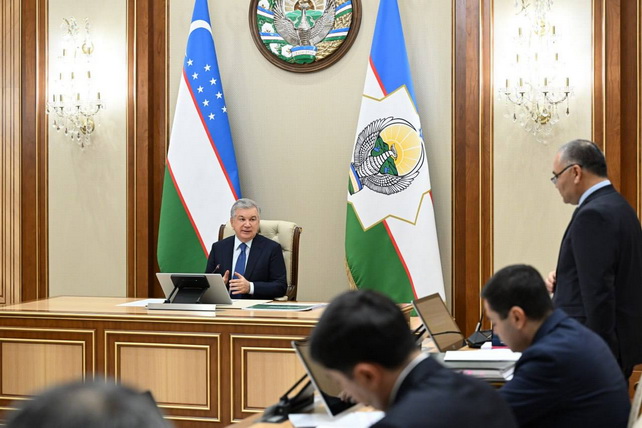
Mirziyoyev Approves Plans to Develop Nearly 1 Million Hectares of Pasture and Reform Agricultural Science
Tashkent, Uzbekistan (UzDaily.com) — On 9 February, President Shavkat Mirziyoyev reviewed a comprehensive presentation on expanding agricultural land and modernizing scientific activity in the agrarian sector.
It was noted that over the past five years, large-scale irrigation and land-reclamation projects have brought 826,500 hectares into agricultural use. Of this, 409,000 hectares are irrigated, while approximately 418,000 hectares were developed through the use of groundwater on rain-fed and pasture lands, along with the cultivation of low-water crops.
The presentation outlined plans for further improvement and development of pasture lands. By 2030, an additional 938,000 hectares of pasture are expected to undergo reclamation and restoration. In 2026–2027 alone, 620,000 hectares are slated for restoration, 300,000 hectares will be sown with pasture crops, and 130,000 hectares will see the installation of water intake wells. These measures will enable the grazing of around 960,000 small ruminants and increase meat and wool production.
A major focus was placed on the urgent need to overhaul the system of agricultural science. The existing institutional model has exhausted its potential and requires transformation.
It is proposed to consolidate 22 research centers, 260 laboratories, and more than 2,500 scientists and research staff into a single entity — the Academy of Agricultural Sciences.
Priority areas for the academy will include biotechnology and molecular biology, genetic engineering and hybrid seed production, smart agriculture, the use of satellite and drone technologies, land degradation and soil health, organic farming and food security, veterinary science, and digitalization of the agrarian sector. Organizational measures will also be implemented to enhance the efficiency of the academy.
Significant attention was given to agricultural workforce training. Currently, 13,600 students are enrolled at Tashkent State Agrarian University, but due to insufficient practical training, only 55% of graduates find employment in their field. The goal is to create an integrated system combining education, science, and production, ensuring the preparation of specialists in demand on the labor market.
Around 6,800 students will undertake practical training at production enterprises, organizations, and agro-clusters, while over 2,600 students will train in 22 research institutes under the Ministry of Agriculture. It is also proposed to admit children of farmers and their employees who do not meet the standard entrance score on a reduced-fee contract and to shorten the study period from four to three years for seven programs. Students will additionally receive qualifications as tractor operators and training in agro-drone operation.
The presentation also highlighted the work of the Agency for Agro-Industrial Development. Last year, 44,000 hectares of inefficient land were planted with intensive and industrialized orchards and vineyards, creating 37,000 jobs. These plantations will reach full productivity by 2027, generating annual fruit and vegetable exports of up to US$660 million.
Examples include projects in the Sokh district (500 hectares of apples, raspberries, and apricots), Termez district (164 hectares of apricots and peaches), and vineyards of the “Avatar” variety in Ahangaran (309 hectares), Bulungur (550 hectares), and Kuva (60 hectares). In Pap district, 504 hectares were planted with peaches and plums.
In 2026, plans include establishing 25,500 hectares of fruit orchards and 5,000 hectares of vineyards, creating 48,000 permanent and seasonal jobs.
The need for import substitution in seed material was also emphasized. Uzbekistan currently imports seedlings worth about US$60 million annually, despite having suitable conditions for domestic production to European standards. The agency has created a collection of over 200 virus-free, high-yielding parent fruit varieties. To propagate these and supply regional planting material, complexes with in vitro laboratories and parent nurseries are being established on 50 hectares in Bektemir and 75 hectares in Yukorichirchik, with a target of starting operations by year-end and achieving annual production of 27 million seedlings.
Following the discussion, the President issued specific directives to the responsible agencies and officials for implementing the outlined initiatives.
#Shavkat Mirziyoyev