Stay up to date with the latest news
Subscribe to our telegram channel

Historic Visit: New Horizons for Strategic Partnership Between Uzbekistan and Pakistan
Tashkent, Uzbekistan (UzDaily.com) — The state visit of the President of the Republic of Uzbekistan, Shavkat Mirziyoyev, to Pakistan can rightfully be described as historic in terms of its scale, the depth of its agenda, and the results achieved.
The visit not only elevated bilateral relations to a qualitatively new level but also effectively formalized Uzbekistan–Pakistan cooperation as a comprehensive strategic partnership, going far beyond traditional intergovernmental dialogue.
The program of the visit was exceptionally intensive, reflecting the parties’ shared aspiration to build a long-term, institutionally sustainable model of cooperation. A key political milestone was the first session of the High-Level Strategic Partnership Council, established in February 2025 during the visit of Pakistan’s Prime Minister Shehbaz Sharif to Uzbekistan.
The launch of this mechanism marks a transition from fragmented interactions to systematic coordination in politics, economics, and humanitarian matters at the highest level.
Separate meetings with President of Pakistan Asif Ali Zardari and Prime Minister Shehbaz Sharif confirmed a high degree of political trust and alignment on key issues concerning bilateral relations, regional security, and sustainable development.
During the visit, President Mirziyoyev also met with Pakistan’s Chief of Defence Staff, Field Marshal Asim Munir, demonstrating a mutual commitment to expanding cooperation in security and military-technical spheres.
Such collaboration is particularly relevant today amid global uncertainty, fragmented supply chains, rising protectionism, intensifying geopolitical tensions, and climate and resource challenges. In this context, the strategic partnership between Tashkent and Islamabad serves as a key factor in the resilience and stability of the wider macroregion, providing a reliable platform for joint responses to contemporary challenges.
A distinctive feature of the current stage of Uzbekistan–Pakistan relations is its comprehensive nature. The partnership encompasses politics, economy, investment, transport and infrastructure, industrial cooperation, digital technologies, education, science, and culture. Essentially, it represents a new model of interregional connectivity, fostering job creation, income growth, and strengthening the economic resilience of both countries.
On a broader scale, this cooperation contributes to shaping a new connectivity architecture in Central and South Asia, supporting economic growth and regional stability.
The economic dimension of the visit emerged as a central practical outcome. A high level of political trust laid a solid foundation for dynamic growth in trade and investment, which today serve as the main drivers of bilateral engagement. Between 2017 and 2025, trade turnover between Uzbekistan and Pakistan increased from approximately US$30 million to nearly US$500 million, demonstrating a more than fifteenfold rise in less than a decade.
The parties set a near-term strategic goal of raising bilateral trade to US$2 billion, supported by the establishment of a joint working group and the development of a five-year “roadmap.” This growth is not only quantitative but also represents a qualitative transformation of trade structure, creating a more diversified and resilient model that includes high value-added products: industrial goods, textiles, pharmaceuticals, agricultural products, and construction materials.
During the visit, the parties agreed to expand the list of trade preferences: a preferential regime will now apply to more than 40 product categories on each side, alongside increased issuance of phytosanitary permits. These measures significantly reduce trade barriers and accelerate growth in bilateral trade.
Investment cooperation also shows steady positive momentum. In 2024, Pakistani investment in Uzbekistan’s economy amounted to about US$33 million, and by early 2025 it had more than doubled to nearly US$70 million, reflecting growing interest from the Pakistani private sector and strengthening confidence in Uzbekistan’s investment climate. Currently, around 230 enterprises with Pakistani capital operate in Uzbekistan, exceeding previous levels. These companies are active in agriculture, textiles and food processing, mining, construction materials, pharmaceuticals, and the banking and financial sector.
To implement these strategic and investment priorities, a business forum was held during the visit, attended by the President of Uzbekistan and the Prime Minister of Pakistan. The forum provided a platform for discussing concrete joint projects, strengthening business ties, and expanding cooperation in high-tech and manufacturing sectors. It also created opportunities for workforce development, technology transfer, and access to new markets, directly supporting Uzbekistan’s goals of technological modernization and economic development.
President Mirziyoyev held separate meetings with leaders of leading Pakistani companies — Engro Group, Gohar Textile, Go Group, and HRL Group — active in agriculture, food, textiles, and chemical industries. Discussions focused on joint projects, implementation of modern technologies, training of highly skilled personnel, and expansion of export potential.
The agreements reached carry strategic significance for Uzbekistan’s economy, promoting technological modernization of key industries, strengthening the private sector, expanding access to international markets, and establishing long-term joint investment projects. During the visit, a portfolio of joint projects valued at approximately US$3.5 billion was formed, demonstrating serious and long-term business interest in bilateral cooperation. The institutional strengthening of economic interaction is further supported by the decision to create the Uzbek-Pakistani Business Council, which will serve as a permanent platform for coordinating joint projects, facilitating direct interaction between enterprises, exchanging experience, and developing business initiatives at the economic actor level.
Overall, the multifaceted nature of Uzbekistan–Pakistan relations was concretely reflected in the adoption of over 30 bilateral documents during the visit. They cover nearly the full spectrum of contemporary intergovernmental engagement — foreign policy and security, trade and investment cooperation, industry, agriculture, digital technologies, science and education, culture, environment, emergency response, as well as humanitarian and law enforcement areas. The depth and broad coverage of the agreements extended to regional and academic levels.
Decisions were made to establish a Forum of Regions and mechanisms for direct interaction between the cities of Termez and Peshawar, as well as Samarkand and Islamabad, creating a sustainable institutional foundation for interregional cooperation, business contacts, and humanitarian exchanges.
Agreements were also signed between the Institute of Strategic and Interregional Studies under the President of Uzbekistan and the Islamabad Institute of Strategic Studies, as well as between the Tashkent University of Oriental Studies and the University of Peshawar. These arrangements provide a long-term platform for joint workforce training, implementation of scientific and educational programs, and expert support for the bilateral agenda, giving practical content to the strategic partnership and ensuring its sustainability.
The strategic importance of the visit was particularly evident in transport and logistics. Expanding trade and industrial cooperation depends directly on developing transit connectivity. Special attention was given to the Trans-Afghan Railway project, considered not merely infrastructure but a key geoeconomic element capable of providing Central Asian countries with the shortest access to Indian Ocean ports and integrating Afghanistan into regional economic processes.
The project is expected to reduce freight transit time between Pakistan and Uzbekistan from the current 35 days to 3–5 days, cut transport costs by 30–40%, enable up to 3 million tons of cargo transport annually in the first phase, with potential expansion to 15–20 million tons. Complementary plans include developing multimodal routes, including the Uzbekistan–Kyrgyzstan–China–Pakistan corridor, and expanding direct air links with Islamabad, Lahore, and Karachi, strengthening regional logistics connectivity and opening new opportunities for trade and economic cooperation.
Industrial and technological cooperation also received significant emphasis. The parties agreed to expand collaboration in textiles, food, pharmaceuticals and perfumery, construction materials, electrical engineering, and logistics. A separate strategic focus was placed on digital cooperation — creating joint IT clusters, supporting startups, developing digital solutions for business and public services, and exchanging expertise in artificial intelligence and smart technologies. Digital cooperation is viewed as a key tool for accelerating technological modernization and enhancing the global competitiveness of both economies.
Cultural and humanitarian dimensions remain an integral part of the strategic partnership, grounded in centuries of shared historical and civilizational ties. Educational cooperation is growing steadily: the number of Pakistani students in Uzbekistan increased from around 1,300 in 2023 to over 1,600 in 2025, making Pakistan one of the key sources of foreign students in the country and reflecting strengthened academic and scientific links between the states.
Positive dynamics are also evident in the cultural-humanitarian dimension, complementing and reinforcing the economic agenda. Tourism cooperation, for example, grew significantly: in 2025, the number of tourists from Pakistan exceeded 10,000, almost 2.5 times higher than in 2023, supported by direct flights and over 25 joint cultural and tourism events. These developments demonstrate that education, science, tourism, and culture are evolving as dynamically as trade and economic engagement, forming a solid socio-humanitarian foundation for long-term strategic partnership.
To expand humanitarian contacts and mutual cultural exchange, the parties agreed to hold Uzbekistan Culture Weeks and Uzbek Film Days in Pakistan in 2026. Special attention was given to developing systematic cooperation in pilgrimage tourism, which holds significant potential for closer people-to-people ties. Additionally, President Mirziyoyev proposed establishing a joint cultural center in Lahore to promote Baburid heritage, serving as a symbol of shared historical memory and a sustainable platform for deepening cultural dialogue between Uzbekistan and Pakistan.
The state visit received high political and symbolic recognition: President Mirziyoyev was awarded Pakistan’s highest state honor, the Nishan-e-Pakistan, and granted the title of Honorary Doctor and Professor at the National University of Science and Technology, Islamabad. These recognitions reflect appreciation for the personal contribution of Uzbekistan’s President to strengthening bilateral friendship and strategic partnership, as well as acknowledgment of Uzbekistan’s reform and modernization agenda. The academic award emphasizes openness to scientific and educational exchange, encourages joint research programs, and strengthens intercultural and humanitarian ties. Symbolic measures, including the establishment of Tashkent Street and Babur Park in Islamabad, underscore shared historical memory and provide a long-term platform for cultural tourism and friendly relations.
The institutionalization of expert dialogue was another key achievement. The signing of a memorandum to establish the Uzbek-Pakistani Expert Council between the Institute of Strategic and Interregional Studies under the President of Uzbekistan and Pakistan’s Institute of Regional Studies creates a sustainable platform for strategic analysis, monitoring of agreement implementation, and developing practical recommendations for government bodies.
Overall, President Shavkat Mirziyoyev’s visit to Islamabad marked a milestone event that not only confirmed the achieved level of strategic partnership but also laid a strong foundation for its further deepening. It provided a powerful impetus for implementing joint initiatives and reinforced Uzbekistan–Pakistan cooperation as a key factor for resilience, connectivity, and development in Central and South Asia amid global turbulence.
Akramjon Ne’matov
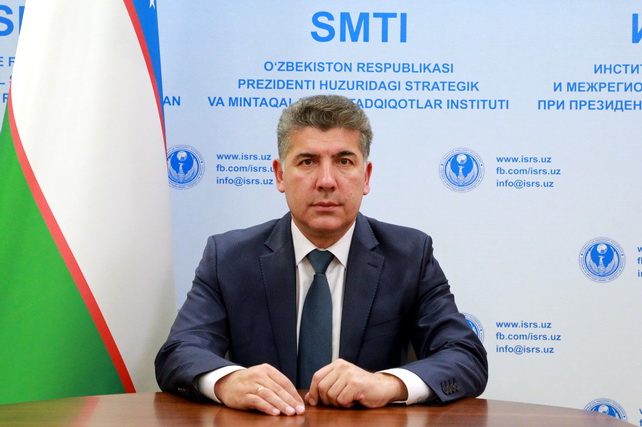
First Deputy Director, Institute of Strategic and Interregional Studies under the President of the Republic of Uzbekistan