Stay up to date with the latest news
Subscribe to our telegram channel

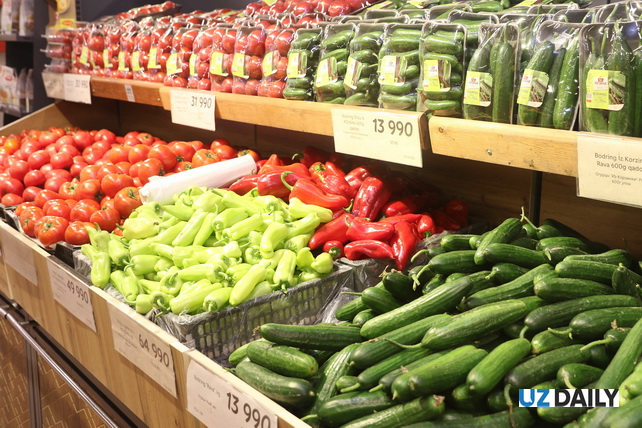
Growth in Uzbekistan’s Fruit and Vegetable Exports and Production Calls for Expansion of Cold Storage Infrastructure
Tashkent, Uzbekistan (UzDaily.com) — Uzbekistan produces over 23 million tonnes of fruit and vegetable products annually, including vegetables (51.1%), potatoes (15.8%), fruits (13.8%), melons (11.4%), and grapes (7.8%).
However, processing levels for certain products do not exceed 10–15%, while post-harvest losses are estimated by experts at 20–30%.
The sector is largely driven by 5.5 million dehkan and household farms, which account for 54.9% of total fruit and vegetable output. Reducing losses could generate an additional US$1.1–1.7 billion (based on 2024 prices) for these farms, contributing to poverty reduction, which stood at 6.8% of the population as of 1 July 2025.
Given the average annual production growth of 3.5% over the past five years, improving crop preservation has become increasingly important.
Cold storage facilities play a crucial role in maintaining product freshness and reducing losses by providing temporary storage without deep freezing, thus preserving both appearance and taste.
As of October 1, 2025, Uzbekistan operated 2,011 cold storage facilities with a total capacity of 1.14 million tonnes. The largest capacities are located in Samarkand (184.8 thousand tonnes, 16.2%), Ferghana (168.2 thousand tonnes, 14.7%), and Tashkent (129.6 thousand tonnes, 11.4%) regions.
Of the total capacity, 50.3% belongs to medium-sized warehouses (100–1,000 tonnes), 46.3% to large ones (over 1,000 tonnes), and only 3.4% to small units (under 100 tonnes).
The average capacity per warehouse nationwide is 567.5 tonnes, with the highest averages in Samarkand (962.7 tonnes) and Tashkent (805.1 tonnes) regions, and the lowest in Navoi (265.4 tonnes) and Bukhara (323.1 tonnes).
Overall, cold storage capacity covers just 4.9% of total annual fruit and vegetable production. Coverage is highest in Tashkent (6.9%), Ferghana (6.4%), Kashkadarya (6.4%), Khorezm (5.6%), and Samarkand (5.2%), and lowest in Syrdarya (2.0%), Bukhara (2.5%), Andijan (3.2%), and the Republic of Karakalpakstan (3.5%).
Industry experts note that to support the country’s export potential, storage capacity should reach at least 75% of exported output.
In 2024, Uzbekistan exported 2.04 million tonnes of fruit and vegetable products, which would require 1.53 million tonnes of cold storage capacity. The current deficit of 385.9 thousand tonnes indicates a need for a 33.8% capacity increase — a shortfall that could become critical as exports continue to grow.
To address this challenge, experts recommend conducting a detailed regional analysis to identify capacity gaps, surveying producers to determine demand by product type and volume, and developing a state support program for constructing new cold storage facilities, prioritizing lagging regions.
Similar programs have been successfully implemented abroad — for instance, in 2023 Georgia launched a co-financing program covering up to 70% of equipment costs for berry storage facilities for agricultural cooperatives. Comparable initiatives have also been carried out in Moldova and Ukraine.
Further recommendations include creating a digital logistics map showing the location of cold storage facilities, shock-freezing projects, and processing plants, as well as exploring the placement of lightweight cold storage units directly on farmland.
For perishable crops such as cherries, smaller-capacity or mobile container-type refrigerators are ideal, as they require no permanent infrastructure, can move between producers during harvest season, and allow temperature control tailored to specific crops.
Expanding cold storage capacity will help reduce post-harvest losses, increase farmers’ incomes, and ensure stable year-round supply of fresh produce to domestic and foreign markets.