Stay up to date with the latest news
Subscribe to our telegram channel

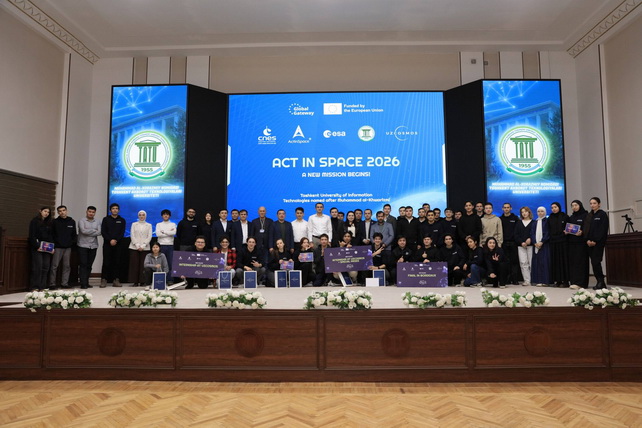
EU Supports National Space Technology Hackathons in Kazakhstan and Uzbekistan for 200 Young STEM Entrepreneurs
Tashkent, Uzbekistan (UzDaily.com) — The European Union has supported a space technology competition for young STEM entrepreneurs in Kazakhstan and Uzbekistan as part of the “Digital Connectivity in Central Asia” (C4CA) program.
This year, C4CA organized national selection rounds in both countries for the first time under the “Team Europe Initiative” (TEI), aimed at fostering digital interconnectivity across the region.
From 30 to 31 January 2026, more than 200 participants—100 from each country—took part in the ActInSpace hackathon, tackling technical challenges with expert guidance. The event was supported by national digital agencies and scientific institutions in Kazakhstan and Uzbekistan. In Kazakhstan, partners included the Aerospace Committee of the Ministry of Artificial Intelligence and Digital Development, the Republican Space Communication Center, and the Kazakh National Research Technical University named after K.I. Satpayev. In Uzbekistan, the project involved the Agency for Space Research and Technologies under the Ministry of Digital Technologies and Tashkent University of Information Technologies named after Muhammad al-Khwarizmi.
Over two days, teams worked intensively to develop projects and prototypes, receiving remote support from the European Space Agency (ESA) and France’s National Center for Space Studies (CNES). Participants created business plans and prototypes, consulting both local experts and specialists from ESA and CNES.
At the conclusion of the competition, a jury selected winners in each country from three finalists. In Kazakhstan, the winning team was SUniverse, consisting of five members, while in Uzbekistan the victory went to NazarX, also composed of five participants.
The SUniverse project developed a machine learning-based classification system for data analysis and decision support, capable of extending the operational lifespan of satellites by identifying patterns in incoming data. NazarX presented a modular satellite design platform with magnetically connectable components, which can be used for assembly, upgrades, and repairs both on Earth and in orbit, following a LEGO-like principle to make technology accessible and affordable.
The winning teams will have the opportunity to present their projects at the grand finale in Bordeaux, France, alongside the best teams from other countries. Teams placing second and third will be able to participate in internship and incubation programs.
“This event is a key element of the European Union’s Global Gateway strategy and for the entire Central Asian region, as it stimulates innovation in the space sector and supports young entrepreneurs, strengthening cooperation between the EU and regional countries. It is an example of successful partnership between government authorities and the private sector,” said Johannes Bauer, Head of the Cooperation Department at the EU Delegation in Kazakhstan.
“We hope that this collaboration will help build a strong talent pool for the space industry and further promote space innovation between Central Asia and EU institutions,” added Olivier Stemler, Deputy Head of Mission at the Embassy of France in Uzbekistan.