Stay up to date with the latest news
Subscribe to our telegram channel

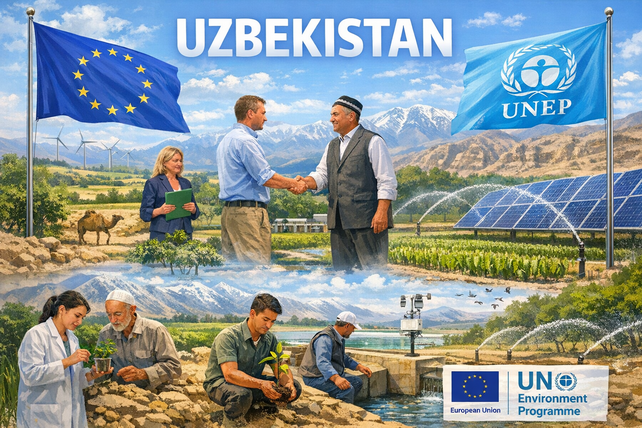
EU and UNEP Back Climate Resilience Projects in Central Asia
Tashkent, Uzbekistan (UzDaily.com) — The European Union and the UN Environment Programme (UNEP) are supporting local community projects aimed at enhancing climate resilience and strengthening social cohesion across Central Asia.
The initiative is part of the EU-funded regional program “Facilitating region-specific approaches to addressing climate and environmental risks for peace and socio-economic stability in Central Asia.” Following a competitive selection in August 2025, eight local civil society organizations were chosen to implement community-led initiatives.
Between October and December 2025, communities in Kyrgyzstan, Tajikistan, and Uzbekistan identified and prioritized 17 local climate adaptation measures. These measures were developed in consultation with local authorities and community groups to address interlinked climate, environmental, and socio-economic challenges in the Ferghana Valley, a recognized regional climate hotspot.
The densely populated valley faces worsening droughts, extreme heat events, water shortages, land degradation, and declining biodiversity. Rising risks of floods and dust storms are compounded by socio-economic pressures, including competition for land and water, reduced agricultural productivity, limited employment opportunities, forced migration, and increased family stress.
Selected interventions focus on nature-based solutions, emphasizing ecosystem restoration and sustainable resource management. Initiatives include agroforestry, green infrastructure, and ecosystem rehabilitation, ranging from protective forest belts and eco-parks to nurseries and restoration of degraded landscapes.
Special attention is given to climate-resilient water management, including watershed restoration, rehabilitation of irrigation canals using natural reinforcements, creation of community reservoirs with buffer zones, water collection systems, and joint resource management mechanisms.
Projects also aim to promote climate-smart agriculture and nature-based livelihoods, such as rehabilitating degraded land, cultivating drought-resistant crops, supporting pollinators through beekeeping, implementing vermicomposting, and developing greenhouse farming. Pasture ecosystem restoration and natural soil moisture retention measures are included as well.
Local communities actively participate in all initiatives, applying local governance mechanisms to ensure transparent and equitable resource distribution. The interventions are expected to reduce tensions over scarce land and water, bolster livelihoods, and enhance collaboration among communities and local stakeholders.
Restoration efforts—covering watersheds, irrigation canals, orchards, pastures, and protective forest belts—are designed to improve soil water retention, stabilize slopes, reduce erosion, enhance water quality and microclimates, and increase biodiversity. The projects also create employment opportunities, empower women and youth, and foster community cooperation through traditional collective labor (hashar) and public dialogues on shared resource management.
The EU–UNEP partnership was established in 2017 to strengthen the capacity of countries and organizations to identify climate and environmental risks and develop nature-based solutions for peace and stability. The program is currently in its second phase (2022–2027), covering multiple regions, including Central Asia, with a particular focus on the Ferghana Valley, home to millions dependent on irrigated agriculture and livestock, who are increasingly affected by climate change and water scarcity.
The regional initiative is fully funded by the EU with technical support from UNEP. Implementation is led by the Scientific-Information Center of the Interstate Coordination Water Commission as a regional partner, in close coordination with EU delegations in Kyrgyzstan, Uzbekistan, and Tajikistan.