Stay up to date with the latest news
Subscribe to our telegram channel

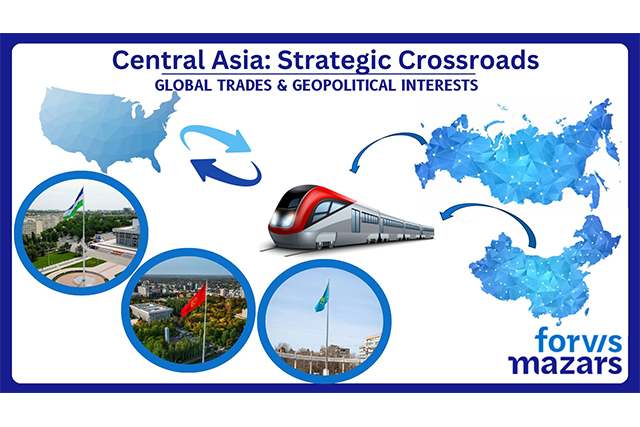
Central Asia at the Crossroads: Chinese Investment, Russian Turbulence, and the Fragile Balance of Regional Economics
Tashkent, Uzbekistan (UzDaily.com) — Kazakhstan, Uzbekistan, and Kyrgyzstan are entering a phase where traditional growth models based on resource extraction and transit routes no longer guarantee economic stability. According to a comprehensive assessment by consulting firm Forvis Mazars, "the region is gradually ceasing to be a periphery of the global economy and is transforming into a space where the interests of leading powers, alternative logistics routes, and sources of resource resilience intersect."
China's Economic Stranglehold
The scale of China's presence in Central Asia is unprecedented. During 2025, Kazakhstan received $25.8 billion in investments through the Belt and Road Initiative, making it the region's largest recipient. Roughly half of these funds—$12 billion—flowed into aluminum production, while another $7.5 billion was channeled into copper mining and refining.
Yet investment tells only part of the story. According to Forvis Mazars analysts, "the concentration of trade, investment, and logistics flows in a single direction creates structural dependency, heightening the economy's sensitivity to external decisions." Over the first ten months of 2025, Kazakhstan exported $12 billion worth of goods to China—representing 19 percent of total exports—while importing $15 billion from Beijing, which accounts for 29 percent of its imports.
Uzbekistan faces an even starker situation. China maintains dominant influence through investment and infrastructure megaprojects. By January 1, 2026, the country hosted 5,044 enterprises with Chinese capital. The trade imbalance is staggering: over eleven months of 2025, Uzbekistan exported only $2 billion in goods to China while importing $13 billion. Forvis Mazars warns that this creates a "one-sided dependency where the country becomes vulnerable to external price fluctuations, shifts in demand, and Beijing's policy decisions."
The China-Kyrgyzstan-Uzbekistan railway project, valued at $4.7 billion—equivalent to more than 26 percent of Kyrgyzstan's GDP—intensifies this pressure. Though financing was formally agreed in December 2025, the debt burden is becoming a strategic vulnerability. Kyrgyzstan's total government debt stands at approximately $6.6 billion, or 37.6 percent of GDP.
Russia: A Shifting Trade Paradigm
Russia remains a critically important trading partner for Kazakhstan and Kyrgyzstan, particularly for non-resource exports. However, its role is transforming rapidly. Moscow's tightening of customs controls—aimed at combating "gray" imports and dual-use goods—is fundamentally restructuring the entire trading regime.
Forvis Mazars analysis notes that "this represents not temporary disruptions, but a structural shift in trade rules. For Kazakh companies, this means heightened demands for supply chain transparency, certification, and logistics planning." Border delays are mounting, transaction costs are climbing, and small and medium-sized enterprises are finding their competitive advantages eroding.
For Uzbekistan and Kyrgyzstan, Russia remains the dominant source of remittances. In Uzbekistan, transfers from Russia accounted for roughly 78 percent of all international inflows during the first half of 2025, totaling $8.2 billion. By November 2025, Kyrgyzstan had received a record $3.22 billion in remittances, with 93 percent originating from Russia. Yet the tightening of migration policies introduces profound uncertainty, threatening to severely undermine both economies' financial stability.
Water, Energy, and Long-Term Structural Threats
While geopolitics and investment shape near-term prospects, water and energy constraints are emerging as long-term growth limiters. Afghanistan's planned Qosh Tepa Canal—approximately 285 kilometers long—poses a direct threat to the region's entire water balance. The canal is designed to irrigate over 500,000 hectares and will divert water from the Amu Darya, potentially reducing its flow into Uzbekistan and Turkmenistan.
According to the Forvis Mazars assessment, Kazakhstan could lose as much as 30 to 40 percent of its water supplies. This threatens agricultural production in southern regions and creates serious ecological risks. Kyrgyzstan, meanwhile, is experiencing glacier retreat and dwindling reservoir capacity. An emergency situation was declared in the energy sector nearly two years ago, with only $100 million budgeted in 2024 to cover the deficit.
Kazakhstan and Uzbekistan have agreed to supply electricity to Kyrgyzstan during the autumn and winter months, allowing water to accumulate in reservoirs for spring release. This interim arrangement demonstrates that without long-term coordination and investments in water conservation technologies, water scarcity could become a critical constraint on economic development.
Oil, Gold, and Currency Volatility
Kazakhstan remains heavily dependent on oil. Roughly 40 to 50 percent of the state budget is generated from hydrocarbon extraction and export. In early March 2026, Brent crude traded near $82 to $83 per barrel, buoyed by Middle East tensions. However, analysts caution that this spike reflects short-term geopolitical anxiety rather than fundamental supply-demand dynamics, which point toward possible oversupply.
A critical vulnerability is dependence on Russian infrastructure. Approximately 80 percent of Kazakh oil exports flow through the Caspian Pipeline Consortium, with Italy serving as the key transshipment point. Pipeline incidents and geopolitical instability pose serious logistics risks. Kazakhstan is exploring alternative routes southward across the Caspian and toward China, but displacing the Russian corridor remains difficult in the medium term.
For Uzbekistan and Kyrgyzstan, gold serves as a more dependable buffer. Uzbek gold exports reached approximately $9.8 to $9.9 billion in 2025, accounting for roughly 37 percent of commodity exports. JPMorgan forecasts gold prices could reach $6,300 per ounce by year-end 2026. Kyrgyzstan also relies on gold—the country officially exported 6.2 tonnes over the first ten months of 2025, though international data suggests significantly larger volumes.
Macroeconomic stability across the region remains fragile. Kazakhstan's inflation finished 2025 at 12.3 percent, prompting the National Bank to maintain its key rate at 18 percent. The tenge weakened dramatically to around 550 per dollar during summer 2025, necessitating direct central bank currency interventions.
Diversifying Routes: The Iran Factor
Against mounting tensions between Russia and the West, and escalating Western sanctions pressure, Central Asian nations are attempting to diversify logistics through Iran. Trade between Kazakhstan and Iran reached $396.1 million in 2025, up 33.6 percent year-over-year. A container service launched along the Kazakhstan-Turkmenistan-Iran-Turkey route has streamlined logistics, with North-South corridor traffic surging nearly 53 percent.
Yet airstrikes on Iranian territory and the loss of senior state officials threaten significant disruption. According to Forvis Mazars, "destabilization of the political system could trigger infrastructure failures and rising insurance and logistics costs. In the short term, this will intensify uncertainty and trade risks, but in the medium term, it may prompt Kazakhstan to more aggressively diversify routes across the Caspian and South Caucasus."
Iranian blockade of the Strait of Hormuz presents a dual threat. On one hand, shipping restrictions could trigger oil price spikes, which would benefit regional hydrocarbon exporters. On the other hand, soaring energy costs in China would feed through into higher prices for Chinese goods—the primary source of imports for the entire region. Given already elevated inflation, this creates additional pressure on real incomes and living standards.
Digital Transformation as a Path Forward
Against a backdrop of external headwinds, digital transformation is emerging as the most promising avenue for structural change. In Kazakhstan, Astana Hub brings together approximately 2,000 IT companies generating $1 billion in service exports. In Uzbekistan, the first national "unicorn"—the fintech holding Uzum—raised $70 million from Tencent and VR Capital in August 2025, valuing the company at $1.5 billion.
Uzbekistan is deploying artificial intelligence modules to automatically calculate market-based prices for government procurement starting March 2026, aiming to boost transparency and reduce corruption. The plan targets 1,500 state services delivered digitally by 2030, with budget savings projected at 25 trillion som.
Conclusion: Balancing Dependency and Self-Determination
Central Asia stands at a critical juncture. As Forvis Mazars concludes, "quantitative growth powered by natural resources, transit fees, or trade expansion can no longer guarantee stability. The key challenge is transitioning from simple scaling to managing complexity: the capacity to account for external macroeconomic effects, diversify economic models, balance between competing external powers, and build resilient domestic institutions."
Kazakhstan, Uzbekistan, and Kyrgyzstan possess the necessary assets—from mineral resources to human capital. Yet without structural reforms, investment in water conservation, energy diversification, and digital infrastructure, the region risks remaining a passive object of global forces rather than an active architect of its own future. Over the coming two to three years, decisions made in Astana, Tashkent, and Bishkek will determine whether Central Asian nations can forge an autonomous development path or will remain caught in the gravitational pull of external powers.
|
Forvis Mazars is an international, independent, and integrated professional services firm providing audit, accounting, tax, and consulting services. The company possesses deep expertise in analyzing economic and geopolitical developments across Central Asian nations, including Kazakhstan, Uzbekistan, and Kyrgyzstan. This report and analysis have been prepared by the Forvis Mazars Central Asia team based on comprehensive research of macroeconomic trends, investment flows, trade patterns, and geopolitical factors shaping regional development.
|