Stay up to date with the latest news
Subscribe to our telegram channel

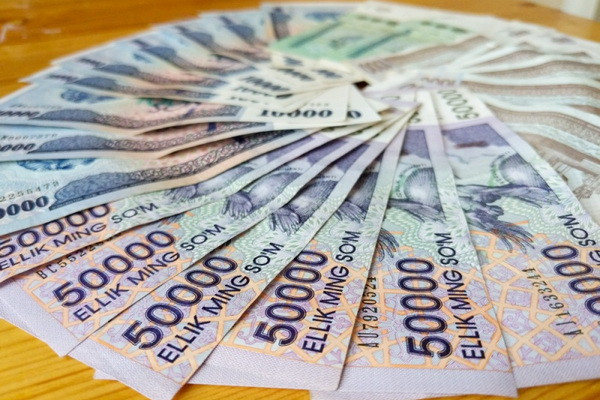
Average Monthly Salary in Uzbekistan Increased by 18.9% in 2025
Tashkent, Uzbekistan (UzDaily.com) — In 2025, the average monthly nominal salary in Uzbekistan reached 6,376.7 thousand soums, representing an 18.9% increase compared to the previous year, according to the National Statistics Committee.
By region, the highest salaries were recorded in Tashkent at 10,753.8 thousand soums, up 18.3% from 2024. Other regions saw the following average monthly wages: Namangan — 4,751.3 thousand soums (+22.8%), Syrdarya — 5,119.1 thousand soums (+20.8%), Jizzakh — 4,786.0 thousand soums (+20.5%), Ferghana — 4,730.2 thousand soums (+19.1%), Khorezm — 5,052.4 thousand soums (+18.4%), Kashkadarya — 4,476.7 thousand soums (+18.2%), Samarkand — 4,737.6 thousand soums (+17.8%), Surkhandarya — 4,481.8 thousand soums (+17.4%), Bukhara — 5,093.1 thousand soums (+17.2%), Tashkent region — 5,967.7 thousand soums (+16.9%), Navoi — 7,871.6 thousand soums (+16.0%), Karakalpakstan — 5,003.1 thousand soums (+15.7%), and Andijan — 5,238.6 thousand soums (+13.4%). The growth rate in Andijan remained among the lowest in the country.
By economic activity, the highest salary growth was observed in arts, entertainment, and recreation — up 26.4% to 5,448.2 thousand soums. Salaries in education reached 4,372.0 thousand soums (+20.1%), in transportation and storage — 9,659.1 thousand soums (+18.9%), in information and communication — 15,298.1 thousand soums (+15.8%), and in industry — 7,525.1 thousand soums (+16.7%). Wages in accommodation and food services reached 5,090.0 thousand soums (+8.8%), construction — 6,548.8 thousand soums (+9.1%), trade — 6,961.2 thousand soums (+12.0%), healthcare and social services — 3,909.3 thousand soums (+14.5%), and in banking, insurance, and financial services — 17,597.5 thousand soums (+15.2%).
Analysis of changes over the past five years shows significant increases in key sectors. In banking, insurance, leasing, and credit intermediation, the average salary rose by 9,287.7 thousand soums; in information and communications — by 9,720.9 thousand soums; in transport and storage — by 5,418.4 thousand soums; in industry — by 3,246.8 thousand soums; in accommodation and food services — by 2,687.1 thousand soums; and in construction — by 2,588.7 thousand soums.
In industry, salaries were distributed as follows: mining and open-pit operations — 9,863.3 thousand soums, electricity, gas, steam, and air conditioning — 9,218.6 thousand soums, manufacturing — 7,214.2 thousand soums, water supply and waste management — 4,854.0 thousand soums.
In trade, the average salary reached 6,961.2 thousand soums. Salaries in wholesale and retail trade of motor vehicles and motorcycles, including repair, were 9,550.1 thousand soums; wholesale trade (excluding vehicles) — 7,339.6 thousand soums; retail trade (excluding vehicles) — 6,277.4 thousand soums.
In transportation and storage, the average salary was 9,659.1 thousand soums, including warehouse and auxiliary transport — 10,713.4 thousand soums, land and pipeline transportation — 8,149.4 thousand soums, postal and courier services — 4,365.2 thousand soums.
In information technology and communications, salaries averaged 15,298.1 thousand soums: programming and IT consulting — 19,673.9 thousand soums, information services — 18,886.4 thousand soums, telecommunications — 12,174.8 thousand soums.
In banking, insurance, leasing, and credit intermediation: insurance, reinsurance, and pension fund activities — 22,296.0 thousand soums; financial services and auxiliary insurance activities — 19,123.6 thousand soums; financial services excluding insurance and pension — 17,179.5 thousand soums.
In education, the average salary was 4,372.0 thousand soums, including higher education — 10,159.5 thousand soums, technical and vocational education — 4,422.2 thousand soums, general secondary education — 4,278.2 thousand soums, and preschool education — 2,868.5 thousand soums.
Overall, the 2025 data reflects steady growth in salaries across all regions and key sectors of Uzbekistan’s economy, indicating a dynamic labor market and rising household incomes.