Stay up to date with the latest news
Subscribe to our telegram channel

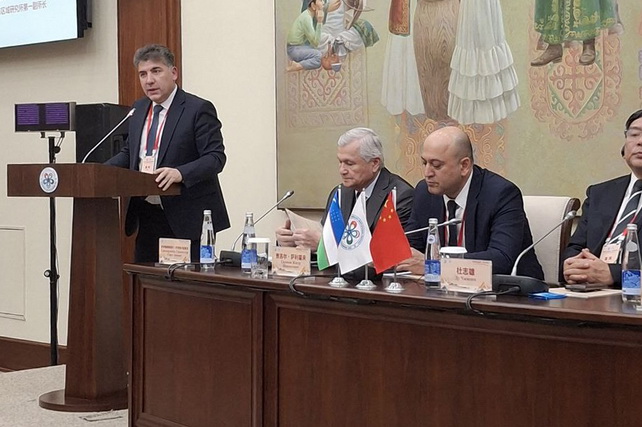
Akramjon Ne’matov: “China Serves as a Significant Example of Effective Governance and Long-Term Strategic Planning for Uzbekistan”
Tashkent, Uzbekistan (UzDaily.com) — On 29 January, a Uzbek-Chinese scientific symposium on “Global Transformation and Public Administration” was held in Tashkent. The event was organized by the International Institute of Central Asia in cooperation with the Chinese Academy of Social Sciences (CASS).
The symposium brought together leading officials and experts from academic, analytical, and research institutions of Uzbekistan and China. The Chinese delegation included leadership and prominent experts from key CASS institutes, such as the Institute of World Economics and Politics, the Institute for Rural Development, the Institute of Russia, Eastern Europe and Central Asia, the Institute of Applied Economics of CASS University, the Institute of Quantitative and Technical Economics, the Institute for Borderland Studies of China, among others.
The discussions focused on a comprehensive analysis of the “all-weather” strategic partnership between Uzbekistan and China amid global changes. Across four sessions, participants concentrated on exchanging best practices in public administration, fostering high-tech economic development and “new-quality productive forces,” expanding cooperation under the “Digital Silk Road,” strengthening regional integration, and aligning development strategies of the two countries.
Speaking at the first session, First Deputy Director of the Institute for Strategic and Military Studies under the President of Uzbekistan, Akramjon Ne’matov, highlighted that collaboration in public administration and adoption of effective governance practices constitute a key area of bilateral cooperation.
He noted that the contemporary international environment is undergoing profound transformation. Geopolitical tensions are intensifying, confrontational approaches increasingly dominate international relations, and economic interdependence is often used as a tool of political influence. Protectionism and restrictions in trade, investment, finance, and technology are becoming persistent practices.
Additional pressure stems from structural global challenges, including climate change, environmental requirements, digitalization, automation, and the rapid development of artificial intelligence.
For developing countries like Uzbekistan, these trends generate complex systemic risks due to geographic constraints, demographic growth, technological costs, and climate challenges, making it imperative to develop long-term, scientifically grounded, and institutionally coherent state policies.
Ne’matov emphasized that the Uzbek government fully recognizes the scale of global transformations and has formulated a comprehensive national development strategy, which is already yielding tangible results.
In 2025, Uzbekistan’s economy exceeded US$140 billion for the first time, foreign investment inflows reached nearly a third of GDP, foreign trade grew by 25 percent, and foreign exchange reserves surpassed US$60 billion. The unemployment rate fell to 5 percent, and over 1.5 million people were lifted out of poverty.
In his recent address to the Oliy Majlis and the people of Uzbekistan, President Shavkat Mirziyoyev stressed that the country must not merely adapt to global changes but develop its own model of growth, leveraging internal potential while effectively utilizing international opportunities.
Within this context, Ne’matov underlined the importance of China’s experience for Uzbekistan. As a close neighbor and strategic partner, China serves as a significant example of successful state governance, technological development, and long-term strategic planning. He noted that the priorities outlined at the 4th Plenary Session of the 20th CPC Central Committee, within China’s 15th Five-Year Plan, largely resonate with Uzbekistan’s national development objectives.
Key areas of alignment include the transition to high-quality development, focus on technological self-reliance and innovation sovereignty, ensuring sustainable social progress, and strengthening national security. This strategic alignment allows Uzbekistan to mitigate external risks more effectively, accelerate technology transfer, and integrate confidently into new regional and global economic frameworks.
Drawing from Uzbekistan’s national development priorities and China’s successful practices, Ne’matov highlighted several fields where Chinese experience holds particular practical value.
First, deepening industrial and technological cooperation. He stressed that transitioning from raw material exports to high value-added production chains is crucial for Uzbekistan. Joint R&D centers, transfer of managerial expertise, and development of advanced industrial and agricultural processing are expected to play an essential role.
Second, enhancing transport and logistics connectivity. Multimodal corridors, modernization of transport infrastructure, and implementation of smart logistics solutions are vital for overcoming the country’s geographic constraints.
Third, comprehensive digitalization of public administration and the economy. Cooperation with Chinese tech companies facilitates a shift from isolated solutions to the systemic creation of a digital state, including the use of Big Data and artificial intelligence in governance.
Fourth, “green” economic transformation. Joint projects in renewable energy, energy storage systems, water conservation, and environmental technologies lay the foundation for sustainable development and industrial decarbonization.
Fifth, human capital development. Expanding joint educational programs, professional workshops, and scientific centers helps build a workforce equipped for the new technological era.
In conclusion, Ne’matov stressed that at the current stage, the primary task is to move from a focus on scale and volume to deepening the quality and substance of cooperation, ensuring sustainable socio-economic returns and strengthening mutual trust.
By combining efforts, Uzbekistan and China can construct a long-term “all-weather” comprehensive strategic partnership capable of effectively responding to the challenges of global transformation.