Stay up to date with the latest news
Subscribe to our telegram channel

World Record Solar Power Price: Lessons from Al Dhafra for Uzbekistan’s “Green” Strategy
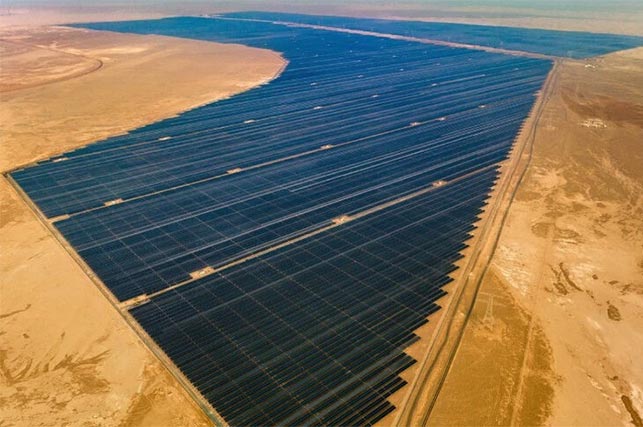
Tashkent, Uzbekistan (UzDaily.com) — The 2 GW Al Dhafra Solar PV plant in Abu Dhabi, the largest solar power station in the world located on a single site, has become a striking example of how large-scale green energy projects can quickly deliver affordable and reliable electricity generation.
Launched in 2023 by a consortium of Masdar, TAQA, EDF Renewables, and JinkoPower, the project already serves as a benchmark for countries aiming to accelerate the energy transition, including Uzbekistan.
Occupying more than 20 square kilometers of desert land, the plant is equipped with nearly four million bifacial solar panels. It supplies electricity to approximately 200,000 households and prevents around 22.4 million tons of CO₂ emissions annually.
In addition, the project set a global record for the lowest solar generation cost—US$0.0132 per kWh—demonstrating that renewable energy can be not only environmentally sustainable but also economically competitive.
Uzbekistan is developing its green energy sector in partnership with international companies. In the updated “Uzbekistan–2030” strategy, presented for public discussion, the government has set ambitious targets for large-scale deployment of renewable energy sources. According to the document, installed renewable capacity is planned to reach 35,000 MW by 2030.
Capacity growth is scheduled in stages: 12,200 MW by 2026, 14,200 MW by 2027, 16,700 MW by 2028, and 19,700 MW by 2029. These projects are expected to increase the share of green generation in the country’s electricity mix from 34.8% in 2026 to 54% by 2030.
The strategy also places particular emphasis on energy storage systems. Their combined capacity is projected to rise from 775 MWh in 2026 to 2,443 MWh by 2030, which is critical for ensuring grid stability amid a high share of solar and wind generation.
According to the Ministry of Energy, Uzbekistan produced 86.7 billion kWh of electricity in 2025, a 6% increase compared to the previous year. Generation from renewable sources, including solar, wind, and hydro, reached 16.8 billion kWh, up 29% from 2024. Solar and wind plants alone produced 10.5 billion kWh, more than double the output of the previous year.
This growth saved 3.2 billion cubic meters of natural gas and prevented the release of 4.7 million tons of pollutants.
By the end of 2025, Uzbekistan operated 148 power plants with a total installed capacity of 25,797 MW, including 3,930 MW of solar PV, 1,652 MW of wind, and 2,441 MW of hydropower. During the year, new generating capacity totaling 4,647 MW was commissioned, including 1,413 MW of solar, 752 MW of wind, and 1,245 MW of battery storage systems. Construction also began on new facilities totaling 3,508 MW, including 2,300 MW of wind generation.
The experience of Al Dhafra highlights key success factors that are already reflected in Uzbekistan’s renewable energy development model.
The scale and technology of large solar parks with modern bifacial panels significantly reduce generation costs and accelerate capacity deployment.
Integration of energy storage systems has become an essential component, without which a power system with a high share of renewables cannot operate stably.
Diversifying energy sources, particularly through the active development of wind generation, complements solar power and mitigates seasonal and daily fluctuations in output.
International partnerships, as demonstrated by Al Dhafra, play a critical role: the consortium of global companies provided financing and technological support for the project.
Experts note that a combination of clear government objectives, transparent project selection mechanisms, and active private capital involvement enabled the UAE to implement Al Dhafra in record time and at minimal electricity cost.
The project clearly shows that large-scale green generation is not a distant prospect but a practical tool for ensuring energy security, economic growth, and emission reduction. This approach now forms the foundation of Uzbekistan’s energy strategy.