Stay up to date with the latest news
Subscribe to our telegram channel

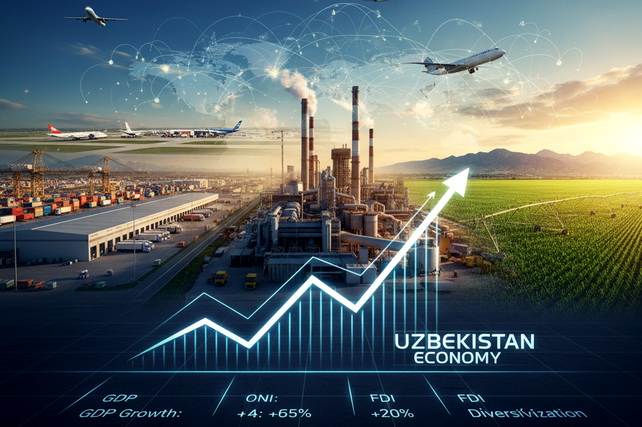
Uzbekistan’s Industrial Production Rises 6.8% in January–November 2025
Tashkent, Uzbekistan (UzDaily.com) — Uzbekistan’s industrial sector continues to demonstrate steady growth. As of 1 December 2025, the country had 59,600 industrial enterprises, according to official statistics. The largest numbers of enterprises were concentrated in food production (11,900), other non-metallic mineral products (8,300), clothing (6,000), fabricated metal products (4,800), furniture (4,100), textiles (3,700), and rubber and plastic products (2,800).
From January to November 2025, these enterprises produced industrial output worth 963.3 trillion soums, representing a 6.8% increase compared to the same period last year.
Industrial output per capita averaged 25.5 million soums nationwide, with higher levels recorded in Navoi region (157.5 million soums), Tashkent city (58.8 million soums), Tashkent region (47.0 million soums), and Andijan region (27.2 million soums).
The growth rate of per capita industrial production across the country reached 104.7%, with higher rates observed in Jizzakh region (112.0%), Namangan (107.0%), Syrdarya (106.9%), and both Navoi and Surkhandarya regions (106.6%).
The structure of industrial output is dominated by manufacturing, which accounted for 825.1 trillion soums, or 85.6% of the total. Mining and open-pit extraction contributed 7.2% (69.3 trillion soums), electricity, gas, and air conditioning 6.6% (63.4 trillion soums), and water supply, sewage, and waste management 0.6% (5.5 trillion soums).
In January–November 2025, production included 38.9 billion cubic meters of natural gas, 601.2 thousand tons of crude oil, 7.5 million tons of coal, over 1.08 million tons of automotive gasoline, 1.07 million tons of diesel fuel, 19.0 million tons of cement, 531.3 thousand tons of yarn, and 1.10 million tons of wheat flour.
Within manufacturing, the largest shares were food, beverages, and tobacco products (19.3%), textiles, clothing, and leather goods (15.4%), machinery, equipment, vehicles, and repair (18.7%), with chemicals, rubber, and plastic products accounting for 7.0%.
By technological classification, manufacturing included high-tech production at 1.1%, medium-high technology at 20.0%, medium-low technology at 39.7%, and low-tech at 39.2%.
Electricity production increased 4.0% year-on-year, while heat generation by large enterprises reached 89.8% of last year’s level. Additionally, textile waste increased by 26.3%, and wastewater treatment and recycling services rose by 15.9%.