Stay up to date with the latest news
Subscribe to our telegram channel

Uzbekistan Turns Climate Challenges into Bold Action
Tashkent, Uzbekistan (UzDaily.com) — Uzbekistan unveils its NDC 3.0 commitment at the COP30 Conference of the Parties of the UNFCCC, hosted by Brazil.
A Challenge Met with Unshakeable Resolve
For millions of people in Uzbekistan, the threat of climate change is not a future concern – it is a daily reality. The loss of the Aral Sea and intensifying drought, water stress, and desertification are not abstract threats; they are actively jeopardizing society’s most vulnerable members and placing communities at risk of food insecurity and major health threats. Despite facing such profound adversity, Uzbekistan is demonstrating the greatest resolve in countering it.
This determination is embodied in Uzbekistan’s newly developed climate pledge: the Nationally Determined Contribution (NDC) 3.0. Endorsed by the Cabinet of Ministers on November 5 and unveiled ahead of the pivotal COP30 Conference in Brazil, this plan sets an ambitious but achievable goal: a 50 percent reduction in Greenhouse Gas (GHG) emissions per unit of GDP by 2035, compared to 2010 levels.
This transformative goal, which builds dramatically upon the previous targets of 10 percent and 35 percent, represents a promise to secure a better future for our children. These commitments align with the Paris Agreement’s 1.5°C goal, and demonstrate Uzbekistan’s determination to lead on climate action.
Our national commitment is fundamentally about people, not just emissions targets. Cleaner energy will improve quality of life and address major health threats. Expanding renewable and green industries will create green jobs, while greener cities and restored ecosystems will make communities more liveable. For people living in vulnerable regions, these changes will bring greater resilience against droughts and water shortages, ensuring a safer, more sustainable future for everyone. As President Shavkat Mirziyoyev emphasized at COP29, achieving these goals will require uniting and engaging every citizen.
2025: Year of Environmental Protection and Green Economy
Uzbekistan has declared 2025 to be the ‘Year of Environmental Protection and Green Economy’, signalling a national commitment to embed sustainability into every aspect of development.
This theme reflects the urgency of the country’s climate reality. Rising temperatures, water scarcity, and the ecological collapse of the Aral Sea all threaten agriculture, infrastructure, and public health – especially in vulnerable western regions.
Against this backdrop, NDC 3.0 represents a decisive shift from incremental progress to transformative action. It is Uzbekistan’s most ambitious climate plan yet, aiming not only to cut emissions but also to link climate ambition with economic modernization. The strategy supports the country’s path toward middle-income status, promotes inclusive growth, and strengthens gender equality in employment. Building a green economy is central to achieving Uzbekistan’s broader social development agenda, ensuring that sustainability and opportunity go hand in hand.
A commitment of this magnitude requires the heart and effort of the entire country. A key priority has been to ensure full engagement of Uzbekistan’s population. This is critical because the nation’s people are young and rapidly growing in number, estimated to reach 40 million by 2030, or half of Central Asia’s total population. Recognizing that this generation will be significantly impacted by climate change in the future, the government introduced a Strategy for Engaging Youth on the Climate Agenda in 2024. This proactive step provides institutional mechanisms, scheduled eco-events, and education in climate science, ensuring our young people are fully equipped to be the leaders who can secure a sustainable, resilient future for Uzbekistan.
Turning Ambition into Action
Uzbekistan’s climate strategy is not a statement of intent, but rather a comprehensive blueprint for transformation that ensures environmental responsibility accompanies economic progress. This vision is already clearly reflected in projects that offer immediate, palpable improvements to daily life.
In Tashkent, the seven-kilometre Green Urban Transport Corridor showcases how mobility can be modernized. Supported by a fleet of 324 electric buses, this infrastructure has streamlined people’s movement through Tashkent City. By reducing emissions and the average citizen’s carbon footprint, it means cleaner air for everyone, while also generating $3.8 million in public income. Far from the capital, at the former Aral Seabed, dedicated efforts are focused on rejuvenation: 80,000 saplings of the hardy Saxaul shrub have been planted on 80 hectares. This effort is specifically designed to protect communities and homesteads threatened by desertification, water scarcity, food insecurity, and major health threats, proving that climate action directly safeguards human security.
Building on these successes, Uzbekistan is scaling up with key commitments that will redefine its development trajectory:
Expanding renewable energy: Increasing renewables capacity to 25,000 MW by 2030, which will make up 54 percent of the national energy mix.
Greening cities and homes: Constructing one million energy-efficient homes and converting 30 percent of urban areas into green zones.
Restoring ecosystems: Forestation of 6.1 million hectares, including 2.3 million in the Aral Sea region, and planting one billion saplings under the "Yashil Makon" initiative.
Managing waste sustainably: Achieving 95 percent coverage of the national solid waste system, with 35 percent of collected waste used for energy generation.
Decarbonizing transport: Expanding electric mobility and creating additional green urban corridors to reduce emissions and improve connectivity.
These actions, supported by partnerships with UNDP, international finance institutions and civil society, will ensure that climate ambition delivers tangible benefits for communities and positions Uzbekistan as a regional leader in sustainable development.
A Challenge We Must Face Together
Uzbekistan has proudly renewed its climate pledge by delivering NDC 3.0, proving that nations most exposed to climate risks are also showing the greatest resolve in countering them. This ambition, however, requires resources on a global scale. Achieving a 50 percent reduction in GHG emissions by 2035 demands mobilizing $33.7 billion for mitigation by 2030, while climate change adaptation measures require an additional $15.7 billion by 2030.
These critical investments are not merely costs; they are the engines of progress. The funds will power renewables, grid modernization, green jobs, and innovation, building the foundation for Uzbekistan’s future as a middle-income country. Furthermore, UNDP’s research provides strong evidence that this low-carbon growth will directly advance social justice, gender equality and human development. This is not just a climate plan – it is a comprehensive strategy for sustainable prosperity.
Now is the moment for action. We call on all stakeholders – from government and private sector leaders to communities and civil society – to join forces. Every partnership matters, and we need partners to combine their expertise, funding, and will-power needed to turn these commitments into a reality.
Climate change is a shared challenge, but if we all assume equal responsibility, we can make it a shared success. Let’s invest today to secure a resilient, inclusive, and sustainable tomorrow – for Uzbekistan, for Central Asia and for the world.
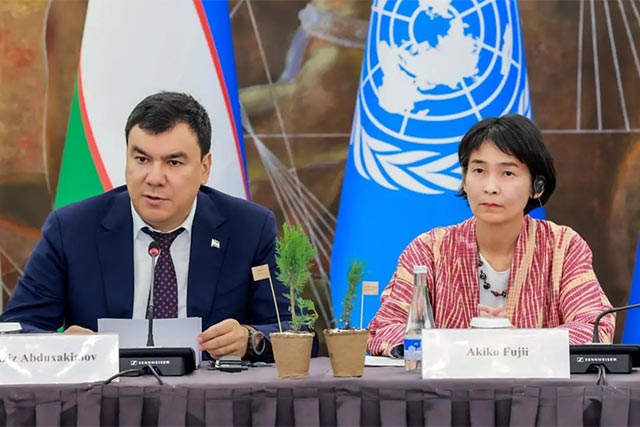
Akiko Fujii
UNDP Uzbekistan Resident Representative
Aziz Abdukhakimov
Advisor to the President of the Republic of Uzbekistan on Environment - Chairman of the National Committee on Ecology and Climate Change