Stay up to date with the latest news
Subscribe to our telegram channel

Uzbekistan Plans to Increase Cocoon Production to 36,000 Tons by 2030
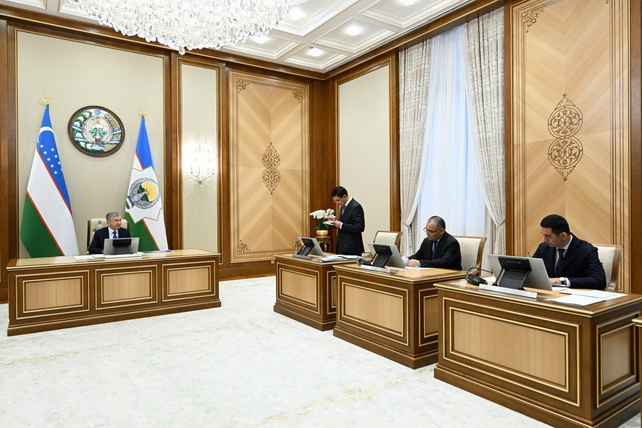
Tashkent, Uzbekistan (UzDaily.com) — President of the Republic of Uzbekistan Shavkat Mirziyoyev reviewed a presentation on measures to develop the silk industry, emphasizing its strategic importance for the country.
Sericulture and the production of silkworm cocoons are an important source of income for the population, promote rural employment, and expand export potential. At the same time, accumulated challenges at all stages—from the feed base to cocoon processing—have constrained the sector’s full growth.
Particular attention is being given to the development of domestic silkworm seed production. Currently, a significant portion of silkworm seed (grena) is imported. By 2030, it is planned to increase the use of locally produced grena to 75%, which will involve restoring the operations of breeding grena stations.
In the near term, new breeding stations will be established in the Fergana and Khorezm regions, and two new grena production enterprises will be launched in Bukhara and Namangan this year. Between 2027 and 2029, four additional enterprises are planned in Tashkent, Jizzakh, Samarkand, and Surkhandarya regions.
To support grena producers and breeding programs, half of the expenses for hiring qualified foreign specialists and paying seasonal workers will be covered, with seasonal employees exempt from personal income and social taxes.
An important element for improving cocoon quality is enhancing the feed base. Between 2026 and 2030, new mulberry plantations will be established on 8,000 hectares, single-row mulberry planting on 41,500 hectares, and 15,000 hectares of existing plantations will be restored.
As a result, 200 million mulberry saplings will be planted, and the feed base will increase by 30%. Cocoon production is projected to reach 30,000 tons in 2026 and 36,000 tons by 2030.
The industry will be organized around a new system, with the Uzbekipaksanoat Association, regional and district AgroPilla structures, and sericulture clusters coordinating the activities of farmers, home-based workers, and cocoon producers, providing support at all stages—from plantation establishment to cocoon purchase.
Special attention will be given to involving low-income families and social benefit recipients, who will receive a 35% subsidy per kilogram of cocoons through the “mahalla seven” program, as well as loans of up to 20 million soums for equipment and tools.
Expansion of industrial cocoon farming is also planned. Currently, most production is carried out at home, but the establishment of specialized silkworm farms will stabilize volumes and quality. Clusters organizing these farms will be exempt from land and property taxes until 1 January 2029.
To increase the added value of the sector and expand exports, efforts will focus on improving quality and deep processing of local raw silk. Implementation of 21 investment projects worth a total of US$200 million by 2030 will allow processing of up to 75% of cocoons—approximately 3,000 tons of raw silk—producing 18.5 million linear meters of silk fabric.
Emphasis will also be placed on promoting finished products to new markets and creating national brands.
The wide adoption of digital technologies is planned, including the creation of a unified information system to track the feed base, maintain enterprise registries, manage reporting, and monitor grena volumes, harvests, and cocoon collection points in real time.
Approving the proposals, the President instructed responsible officials to strengthen the feed base, expand domestic grena production, implement industrial sericulture methods, and increase the share of finished products in the sector’s export structure.
#Shavkat Mirziyoyev