Stay up to date with the latest news
Subscribe to our telegram channel

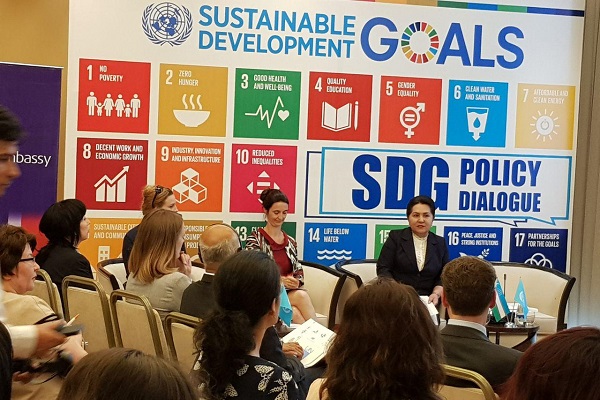
In this dialogue, a draft analytical note "Women’s participation in public administration to accelerate economic, social and institutional transformations" was discussed, which is the first result of the joint efforts of the joint project of the Women’s Committee and UNDP "Women’s empowerment to participate in public administration and increase their activity in the socio-economic life. "
The Dialogue was held to create a platform for discussion, exchange of views and a thorough understanding of the changes that are taking place, and formulating recommendations for the accelerated achievement of the Development Agenda for the period up to 2030. The dialogue brought together representatives of the government, experts, NGOs and the diplomatic community to exchange ideas and knowledge on development issues and achieve the LRC.
UN Resident Coordinator, Permanent Representative of the United Nations Development Program in Uzbekistan Ms. Helena Fraser, in her welcome speech, stressed: "It is very pleasant to open today’s dialogue on the policy of the Sustainable Development Goals. This event enables politicians to share their thoughts, experiences and ideas, and to us - to work together to solve existing problems. Gender equality, empowerment of women and girls are important for economic growth, promoting social development and increasing business efficiency. "
Deputy Prime Minister of the Republic of Uzbekistan, Chairman of the Women’s Committee Tanzila Narbaeva said that the activation of women’s participation in public and political life is one of the priorities of the Women’s Committee of Uzbekistan. Currently, the Women’s Committee of Uzbekistan is undergoing a radical reform of the system, attracting highly qualified personnel who are ready to contribute to the development of the country and society, increasing the prestige of our republic at the international level, and improving the well-being of the population. An analysis of the work on advancement of women showed that there is no mechanism for nominating women with political experience. In this direction, it can be particularly noted that there is practically no joint work of the most interested structure, like the Women’s Committee with political parties, to fight for the opportunity given by the law to win a 30 percent quota in elections to the highest legislative body. To do this, it is necessary to create the necessary conditions, to increase and use the potential of women employed in different spheres. It is necessary to train qualified female personnel for active participation in the socio-social, economic life of the country, work with them, prepare them for the so-called "representation" for work in state bodies. The Women’s Committee of Uzbekistan, in cooperation with a number of UN agencies, supports the expansion of women’s social and political activity by creating favorable conditions for their self-realization in various spheres. "
The current stage of structural reforms is an ideal moment for the factor "women in public administration" to become a new factor of economic breakthrough for Uzbekistan. This requires effective social lifts for the recruitment of mid-level women to increase the proportion of women in the executive from 5.3% to 16-18%. At the same time, it is critically important to deepen the degree of industrialization of the economy by bringing the share of manufacturing industries in GDP from 9.1% to 20%.
It is recommended to increase the enrollment of women with higher education and create a flexible post-graduate education system for women, to increase the effectiveness of the recruitment and promotion channels for women in the executive branch. As a recommendation, it is also proposed to introduce a mechanism that would support women’s entrepreneurship, home-based work and handicrafts. It is also proposed to pilot the creation of separate women’s units in the Ministry of Internal Affairs and the women’s road patrol and tourist service.
As a result of the presentation, the dialogue was held between the participants, who discussed the results and conclusions of the study, as well as measures aimed at increasing the role of women in various spheres of the country’s life.