Stay up to date with the latest news
Subscribe to our telegram channel

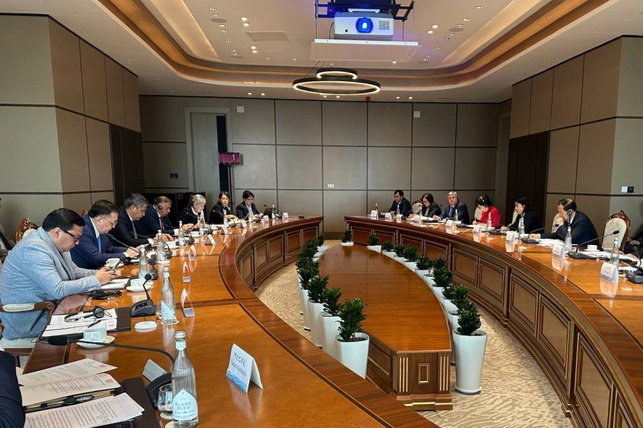
Uzbekistan Highlights Key Areas of Cooperation with China at Samarkand Symposium
Tashkent, Uzbekistan (UzDaily.com) — On 2 April, a symposium of the “China–Central Asia” Knowledge Network was held in Samarkand, organized by the China International Knowledge Center for Development (CIKD) together with the Institute of Macroeconomic and Regional Studies under the Cabinet of Ministers of Uzbekistan.
Experts and analysts from Uzbekistan, Kazakhstan, Kyrgyzstan, Tajikistan, and China, as well as representatives from the Central Asian Regional Economic Studies Institute (CARES), participated in the event.
During the symposium, Shafoat Nurullaeva delivered a report titled “Challenges and Opportunities in Contemporary Global Conditions,” emphasizing that the current stage of world development is marked by deep structural changes, rising geopolitical tensions, and the fragmentation of the global economy.
She noted that economic interdependence increasingly serves as a tool of competitive struggle, while global supply chains and technological linkages are undergoing significant transformations.
According to Nurullaeva, the combination of geo-economic, technological, and climate factors presents states with a complex set of interconnected challenges, requiring not only adaptation but also the ability to develop proactive development strategies. She stressed that institutional quality and strategic management of development are key determinants of competitiveness.
For developing countries, including Uzbekistan, these processes carry the risk of widening technological and institutional gaps, necessitating consistent, evidence-based state policies.
Uzbekistan continues to implement an extensive reform program aimed at sustainable economic growth, improving citizens’ well-being, and enhancing economic competitiveness. Recent achievements include a GDP exceeding US$140 billion, investment inflows of about one-third of GDP, a 25% increase in foreign trade, foreign reserves above US$60 billion, unemployment reduced to 5%, and over 1.5 million people lifted out of poverty.
The country aims to achieve upper-middle-income status and significantly expand its national economy by 2030 while maintaining high growth rates. In the President’s address, Shavkat Mirziyoyev emphasized the need to develop a national growth model based on domestic potential and effective use of international opportunities.
In this context, China’s experience is particularly relevant as a key trade and economic partner, major investor, and source of advanced technology. The priorities of China’s 15th Five-Year Plan (2026–2030), focusing on innovation, green transformation, technological independence, and sustainable growth, align closely with Uzbekistan’s goals.
Key areas for deepening Uzbekistan–China cooperation were identified, including the development of industrial and technological partnerships with high value-added production, strengthening transport and logistics connectivity (notably the China–Kyrgyzstan–Uzbekistan railway project), accelerating digital transformation through AI and big data, promoting a green economy, and investing in human capital through education and science.
Concluding the symposium, Nurullaeva expressed confidence that the combined efforts of Uzbekistan and China will create a long-term framework for a comprehensive and resilient strategic partnership, enabling effective responses to global challenges and supporting sustainable, balanced regional development.