Stay up to date with the latest news
Subscribe to our telegram channel

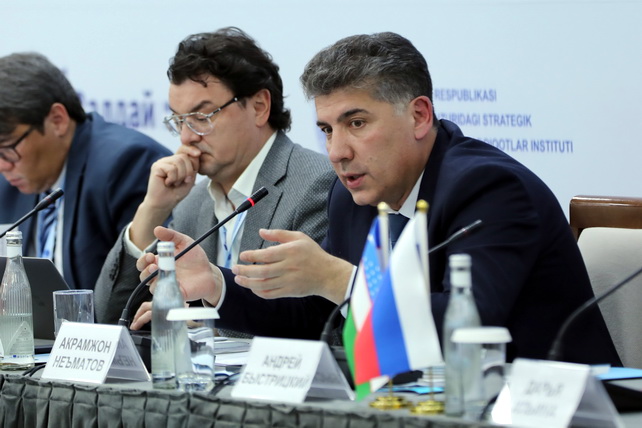
Uzbekistan Develops New Transport Corridors to Mitigate Global Risks
Tashkent, Uzbekistan (UzDaily.com) — Speaking at the international conference “Uzbekistan – Russia: Strategic Partnership in the Eurasian Space” in Termez, Akramjon Nematov, First Deputy Director of the Institute for Strategic and Interregional Studies (ISMI), highlighted the development of Uzbekistan’s transport and logistics infrastructure as a strategic response to global risks. Moderating the session “Connecting North and South: Transport, Logistics, Infrastructure,” Nematov emphasized that a modern, flexible transport system is a shared priority for Uzbekistan and Russia, supported by advanced technological solutions.
The initiative focuses on improving transport and logistics efficiency, establishing cross-border corridors with surrounding industrial and trade clusters, and integrating digital and ICT technologies. The goal is to create a cohesive production and technology ecosystem capable of withstanding external turbulence.
Uzbekistan is actively diversifying transport corridors, developing multimodal routes, and offering shorter connections toward South Asia. These routes are positioned as complementary options, rather than alternatives, to existing networks, minimizing risks and ensuring the continuity of supply chains. The country positions itself as a strategic hub with a growing domestic market and emerging industrial capacity, leveraging its comprehensive transport-logistics ecosystem to access key southern markets efficiently.
The implementation of Uzbekistan’s Transport and Logistics Development Concept until 2030, launched by President Shavkat Mirziyoyev in 2025, aims to remove barriers, reduce transit times, enhance logistics services and 3PL operators, modernize infrastructure, and digitalize systems integrated with international networks. The concept is expected to triple logistics throughput, double international freight transport and logistics service exports, and increase transit volumes to 22 million tons, strengthening Uzbekistan’s position in global rankings.
Digital solutions are also expected to improve shipment transparency, generate additional value, stimulate industrial cooperation, and create growth points along transport corridors. The Termez hub, in this framework, is envisioned as the “southern gateway” linking Central and South Asia, providing the shortest access to Indian Ocean ports.
Nematov concluded that establishing a versatile, high-tech transport network is a strategic imperative for regional stability and the competitiveness of the Eurasian space. Uzbekistan’s modern development model is designed to create an integrated logistics environment, transforming the country into a key freight distribution hub on the continent.
The conference, organized by ISMI and the Valdai International Discussion Club, included participation from Russian Deputy Foreign Minister Mikhail Galuzin, Valdai Club Council Chairman Andrey Bystritsky, ISMI Director Eldor Aripov, Russian and Uzbek diplomatic mission heads Alexey Yerkhov and Batyr Asadov, Surkhandarya regional governor Ulugbek Kosimov, and representatives of expert and analytical circles from both countries.