Stay up to date with the latest news
Subscribe to our telegram channel

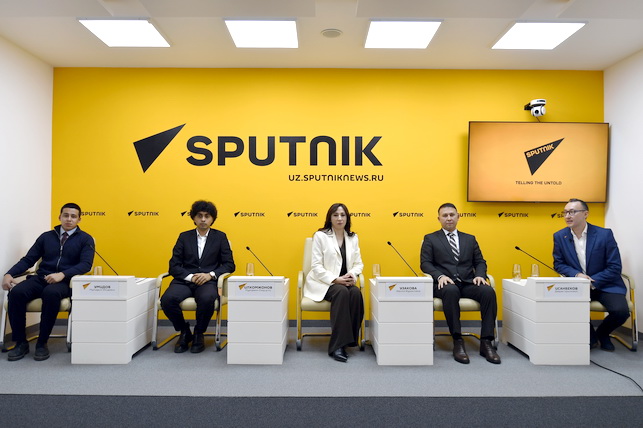
Uzbekistan and Russia Expand Collaboration in Nuclear Energy Workforce Development
Tashkent, Uzbekistan (UzDaily.com) — A Tashkent–Moscow video conference was held at the Sputnik Uzbekistan multimedia press center, dedicated to advancing Uzbek-Russian cooperation in training personnel for the nuclear energy sector.
The key announcement at the event came from Alexander Blagov, Vice President of the National Research Center “Kurchatov Institute,” who confirmed the opening of a branch of the Kurchatov Institute in Uzbekistan.
The branch will be established on the basis of the Institute of Nuclear Physics of the Academy of Sciences of Uzbekistan, and laboratories of the Kurchatov Institute are planned to be launched at the Tashkent branch of the National Research Nuclear University MEPhI.
According to Blagov, shared scientific traditions and similar approaches to education and research provide a solid foundation for deepening the partnership. In the near future, both sides plan to develop a long-term strategy for scientific and technical cooperation.
Davran Isanbekov, Head of the Department for Human Resources Development and Management at the Agency for Nuclear Energy under the Cabinet of Ministers of Uzbekistan, spoke about building the workforce for the nuclear industry.
He emphasized that nuclear energy is becoming a flagship area of industrial development in Uzbekistan and increasingly attracts young professionals. Modern nuclear facilities require not only specialists in nuclear technologies, engineering, and energy, but also experts in IT, robotics, and automation—skills integral to the operation of contemporary nuclear power plants.
Special focus is placed on practical training. Internships at nuclear power plants and participation in international projects in Russia, China, and other countries are an important component of the educational process.
Isanbekov highlighted that systematic work on workforce development has been ongoing since 2019, following the approval of the relevant strategy. One key element was the Tashkent branch of NRNU MEPhI, which has already trained 160 specialists. By 2030, more than 300 students are expected to complete programs in nuclear technologies and energy. Many graduates continue their education at leading Russian universities and gain practical experience at nuclear facilities, including the Novovoronezh Nuclear Power Plant.
Zarina Uzakova, Deputy Director for Academic Affairs at the Tashkent branch of MEPhI, spoke about work with youth and school students. She noted that in February 2026, the first winter school for schoolchildren will begin at the branch with support from the Uzatom agency. The university also actively collaborates with general education institutions, engaging students in scientific research and providing methodological support to teachers.
At the advanced engineering school at the MEPhI branch, the primary focus is on hands-on training. Students follow individualized educational pathways and mentorship programs, and by the fourth year, they begin implementing their own projects. The engineering school, opened in December with support from Rosatom and Uzatom, aims to train both practical engineers and research engineers.
Students also shared their experiences during the video conference. Murodjon Ilkhomjonov, a Nuclear Physics and Technology student, spoke about participation in international hackathons and Rosatom competitions held as part of World Atomic Week, where Uzbek teams presented projects on nuclear infrastructure development and industry modeling.
Mukhiddin Umidov, a student in Electric Power Engineering, highlighted the growing role of digitalization in the sector—from digital twins to automated control systems—enhancing efficiency and reducing risks at nuclear facilities.