Stay up to date with the latest news
Subscribe to our telegram channel

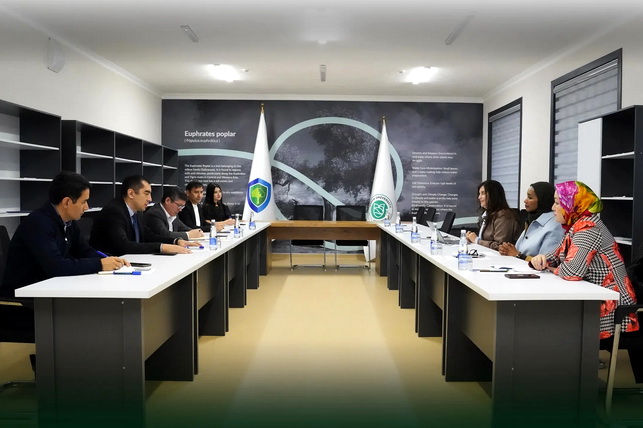
Uzbekistan and ICBA Expand Partnership in Water Resource Management and Climate Resilienc
Tashkent, Uzbekistan (UzDaily.com) — In December 2025, the International Center for Biosaline Agriculture (ICBA) paid an official visit to Uzbekistan as part of its systematic engagement in Central Asia aimed at strengthening cooperation in sustainable agriculture, the rational management of water and land resources, climate resilience, as well as support for education and innovation.
The visit program included a series of high-level meetings and technical consultations with government institutions and the academic community, building on ICBA’s ongoing projects and its many years of cooperation with Uzbekistan.
On Friday, 12 December 2025, ICBA Director General Dr. Tarifa A. Al Zaabi held a high-level meeting with Aziz Abudakhlikov, Adviser to the President of the Republic of Uzbekistan on environmental issues and Chairman of the National Committee on Ecology and Climate Change.
The meeting was also attended by Mohammed Naseeb Al Daheri, Head of the Economic, Political and Media Affairs Section of the Embassy of the United Arab Emirates in Tashkent. The parties discussed the current state of bilateral cooperation and identified further steps to strengthen it in line with Uzbekistan’s national priorities in environmental protection, climate change adaptation, and sustainable development.
Speaking at the meeting, Dr. Tarifa A. Al Zaabi emphasized that Uzbekistan occupies a key place in ICBA’s activities in Central Asia. She noted that the Center works consistently with government bodies, national partners, and the academic community to advance shared priorities in climate resilience, water and land resource management, and sustainable agricultural development.
She stressed that amid ongoing challenges related to water scarcity, land degradation, and climate variability, the visit provided a timely opportunity to assess progress achieved, align approaches with national stakeholders, and enhance coordination on practical initiatives with scaling potential. Particular emphasis, she added, continues to be placed on translating applied scientific research into measurable outcomes that improve resilience, resource-use efficiency, and long-term sustainable development.
Discussions were grounded in ICBA’s current projects and practical work in Uzbekistan, including initiatives in climate-resilient agriculture, sustainable water and land management, and the development of human and institutional capacity. The visit made it possible not only to evaluate results achieved, but also to strengthen institutional coordination and explore opportunities to expand the impact of ongoing initiatives through applied research and innovative solutions.
As part of the visit, a meeting was also held with Shahriyor Nurulloev, Vice-Rector of the Central Asian University for Environmental and Climate Change Studies (Green University). The discussion involved ICBA agronomist and halophyte specialist Dr. Houda Shilaifa and postdoctoral researcher of the Central Asia and Caucasus (CAC) program Dr. Marguba Rejapova.
The parties considered prospects for intensifying technical and academic cooperation, including an initiative to establish a spirulina cultivation laboratory in Tashkent. The project is aimed at strengthening research capacity and ensuring the long-term sustainability of activities within the integrated agriculture–aquaculture system in the Republic of Karakalpakstan.
Overall, the official visit reaffirmed ICBA’s long-term commitment to developing partnerships with Uzbekistan and other countries of Central Asia. It also highlighted the importance of sustainable forms of cooperation that combine policy dialogue, academic engagement, and the practical implementation of projects on the ground.
The meetings demonstrated a shared focus on science-based cooperation designed to support national priorities and develop practical solutions to enhance climate resilience and ensure sustainable development in saline and climate-vulnerable regions.