Stay up to date with the latest news
Subscribe to our telegram channel

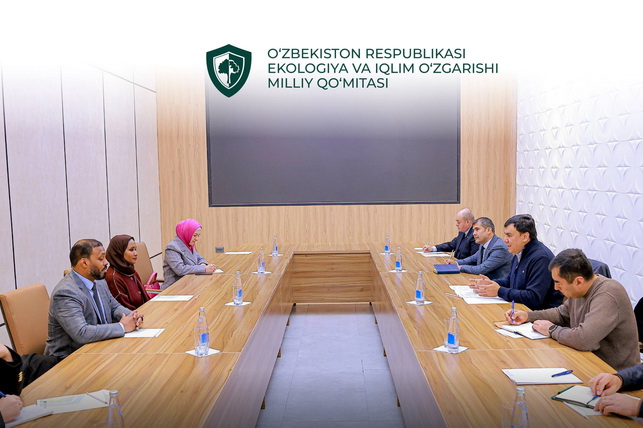
Uzbekistan and ICBA Discuss Sustainable Agriculture in Karakalpakstan
Tashkent, Uzbekistan (UzDaily.com) — Aziz Abdukhaqimov, Advisor to the President of the Republic of Uzbekistan on Environmental Issues and Chairman of the National Committee on Ecology and Climate Change, held a working meeting with Dr. Tarifa Al Zaabi, Director General of the International Center for Biosaline Agriculture (ICBA).
During the talks, both sides expressed mutual appreciation for years of cooperation, highlighting ICBA’s high level of technical expertise in agriculture under arid conditions and in the development of salt-tolerant crops. Special attention was given to Dr. Tarifa Al Zaabi’s role and the center’s international experience in supporting climate-resilient agricultural systems.
Aziz Abdukhaqimov emphasized that the Republic of Karakalpakstan remains one of the country’s most vulnerable regions due to desertification, soil salinization, water scarcity, and the consequences of the Aral Sea’s drying. In this context, the restoration of degraded lands and the strengthening of regional food systems are prioritized.
A key area of joint work is the establishment of sustainable agricultural production systems on degraded lands in Karakalpakstan.
Within this framework, the project “Development of Sustainable Agricultural Production Systems in Degraded Areas of Karakalpakstan,” funded by the Abu Dhabi Fund for Development (ADFD), is being implemented. As a result, over 1,500 farmers across seven districts received training and seeds of 12 approved crop varieties adapted to salinity and arid conditions. In 2025, an integrated agri-aquaculture system (IAAS) worth 1.97 billion soms was created under the project, officially inaugurated in September during a visit by ADFD Director General Dr. Mohammed Saif Al Suwaidi.
The meeting also addressed key directions of national environmental reforms. In particular, it was noted that, by presidential decree, the Ministry of Ecology was transformed into the National Committee on Ecology and Climate Change, and the position of Presidential Advisor on Environmental Issues was established. These changes aim to strengthen environmental governance, improve monitoring efficiency, and accelerate biodiversity conservation measures.
Special attention was given to the creation of the Central Asian Center for Environmental and Ecological Research, whose objectives include forming a digital database of environmental data for arid regions, forecasting ecological changes under desertification and salinization, and developing science-based strategies for managing natural resources, water, and agriculture.
The Azerbaijani side was also informed about the upcoming 8th Assembly of the Global Environment Facility (GEF) and the international exhibition Eco Expo Central Asia–2026, scheduled from May 30 to June 6, 2026, and was invited to participate, including in discussions on environmental financing solutions.
Following the meeting, the foreign delegation visited the Central Asian Center for Environmental and Ecological Research. Guests were introduced to the center’s main activities, its research infrastructure, plans for developing a regional digital environmental database, and initiatives for applied research in sustainable natural resource management.