Stay up to date with the latest news
Subscribe to our telegram channel

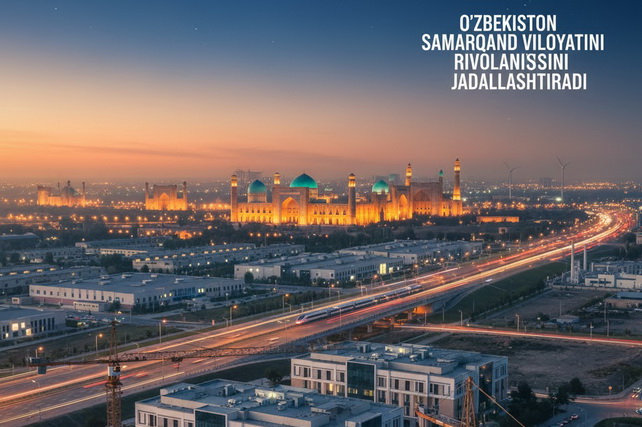
Uzbekistan Accelerates Development of Samarkand Region: Roads, Water Supply, and “Green” Projects
Tashkent, Uzbekistan (UzDaily.com) — President of Uzbekistan Shavkat Mirziyoyev has approved a resolution titled “On measures to further accelerate the socio-economic development of the Samarkand region,” which outlines extensive infrastructure and institutional reforms for the area.
The document aims to create conditions for the implementation of key driver projects and to improve the quality of life for residents.
The resolution approves a targeted program that includes the construction, reconstruction, and repair of 298 km of international, national, and local roads, as well as streets within residential settlements. Fifteen overpasses are also planned.
In the energy sector, the program provides for the repair of a substation, installation of 70 transformer units, and the renewal of 137 km of power grids across 14 districts and cities of the region.
To improve water supply and sewage systems, the construction and repair of 90 water facilities are planned, along with 242 km of water supply networks.
Starting 1 July 2026, tax revenues from water resource usage paid by agricultural enterprises will be fully allocated to district and municipal water supply operators. Additionally, subsidies of 12 million soums per hectare will be provided for cotton fields where drip irrigation systems are introduced.
Beginning from 1 January 2026, all construction, repair, and modernization projects in the region will be implemented in strict accordance with “green” principles and minimum energy-efficiency standards.
In the education sector, starting from the 2026/2027 academic year, an engineering faculty will be opened at the Kattakurgan State Pedagogical Institute in cooperation with Turin Polytechnic University in Tashkent.
Authorities expect that this package of measures will accelerate infrastructure modernization, strengthen the resilience of public utilities, and form a foundation for further economic growth in the Samarkand region.