Stay up to date with the latest news
Subscribe to our telegram channel

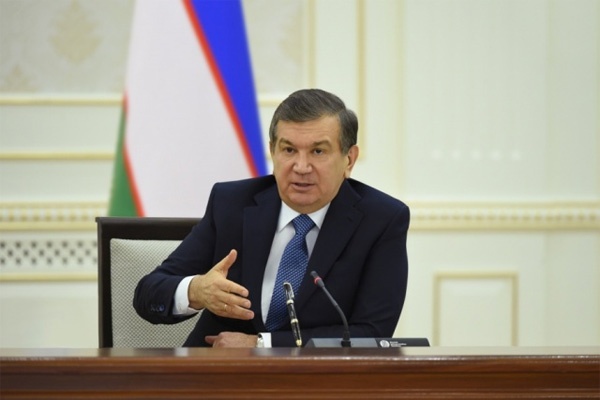
Tashkent, Uzbekistan (UzDaily.com) -- On October 16, the President of the Republic of Uzbekistan Shavkat Mirziyoyev held a meeting on issues of accelerated development of the chemical industry, attracting foreign investment and modern technologies into the sphere.
Chemical industry, being a catalyst of modern industry, has an important place in the economy, since chemical process is the basis of any production.
Uzbekistan’s subsoil contains almost all elements of the periodic table. However, despite the rich reserves of hydrocarbons, the domestic chemical industry specializes mainly in production of mineral fertilizers for agriculture.
Production of complex polymers, catalysts, reagents and synthetic fibers necessary for building materials industry, pharmaceutical, textile, mechanical engineering and other industries has not been established.
As a result, chemical products worth US$1.5 billion are imported annually. Phosphorus and potash fertilizers produced in the country cover only a third of the demand for them.
Capacities for production of complex mineral fertilizers are outdated by 60-70 percent, which leads to waste of energy resources, an increase in the cost of chemical products.
It was noted that since the last year, Uzbekistan launched 17 investment projects worth US$3.1 billion to meet the needs for mineral fertilizers. In addition, in order to diversify the chemical industry until 2025, 17 more projects worth US$4.2 billion will be implemented.
It was noted that attracting foreign investment and modern technologies into the chemical industry, increasing production and expanding the range of products, increasing the export potential are priorities of JSC Uzkimyosanoat.
Upcoming measures on eliminating shortcomings in the industry and further development of the chemical industry were discussed at the meeting. As it was noted, development of the industry requires introduction of new modern production facilities.
Today, the need for nitrogen fertilizers in the country is provided by 73 percent, in phosphorus fertilizers – by 20 percent. The average deterioration level of nitrogen fertilizer production capacities is 64 percent, while phosphorus fertilizers production is 77 percent.
It was noted that it is planned to implement 9 projects worth US$2.8 billion in Uzbekistan over the next five years to improve the situation in the sphere, as the result of which mineral fertilizers and acid sulfate production will double. The demand for nitrogen and potash fertilizers will be fully met, the level of satisfaction of demand for phosphoric fertilizers will increase several times.
At the same time, only 14 percent of natural gas, including 5 percent in the chemical industry, is deeply processed. Production of chemical products from silicon, kaolin and gypsum remains without attention.
According to the available data, there is a demand abroad for products manufactured in Uzbekistan that are not fertilizers, such as polyethylene, polypropylene, polystyrene, in the amount of more than 100 billion dollars. At the meeting it was noted that this is a good opportunity for the country.
In this regard, it is planned to implement 15 projects on production of organic substances and 8 projects on production of inorganic substances in order to diversify the types of products of the chemical industry.
The President of Uzbekistan gave instructions to responsible managers on attracting foreign investors to implementation of these projects.
It is necessary to ensure financial sustainability of the chemical industry to implement large investment projects in the industry. At the meeting, which was chaired by President Shavkat Mirziyoyev on October 16, instructions were given on improving the financial condition of JSC Uzkimyosanoat.
The lack of innovation in the sphere, inefficient use of scientific potential was criticized. The need was noted for speeding up the establishment of a Specialized Center for Research, Design, Engineering and Training at Tashkent Scientific Research Institute of Chemical Technology in cooperation with the Korean Research Institute of Chemical Technology (KRICT).
At the meeting, responsible persons were given instructions on development of a roadmap for implementation of tasks set with further continuous monitoring of its implementation.