Stay up to date with the latest news
Subscribe to our telegram channel

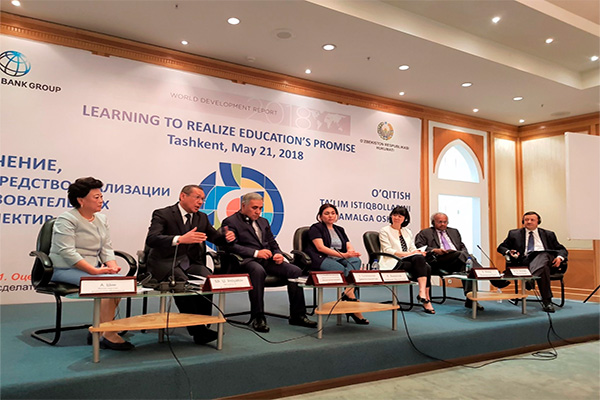
The experts of the bank discussed measures necessary for development of the education sector and training of personnel in Uzbekistan.
The presentation of the report was attended by the Director of the Education Sector of the World Bank (WB) Ms. Keiko Miwa, the WB Education Sector Manager for the Europe and Central Asia Region Mr. Christian Aedo, and the Senior Director for Development Economics and acting chief economist of the World Bank, Mr. Shanta Devarayan. Representatives of the public and private sectors of Uzbekistan, the diplomatic corps, and World Bank partners from various international organizations contributed to the discussion of the report.
The report warns about the "learning crisis" in the world. It not only demonstrates how children in a number of countries do not receive the necessary knowledge and skills, although they attend schools, but also reveals the underlying factors that make learning problems chronic and hinder the development of these countries.
Based on the data obtained through extensive consultations with governments, development organizations, research institutions, NGOs and the private sector in 20 countries, the report has formulated three recommendations for governments:
First, assess learning, to make it a serious goal.
Only half of the developing countries have systems for measuring the quality of knowledge of students completing the primary and primary levels of secondary school. Carefully designed systems for assessing the achievements of students will help teachers work with students, will help improve the management of the system and will help to focus public attention on learning. These measures can help in the rational choice of policy options and monitor progress, as well as identify children in disadvantaged situations.
Second, act on evidence, to make schools work for all learners.
Great schools are those that build strong teachinglearning relationships in the classroom. Thanks to innovations by educators and advances in brain science, knowledge of how students learn most effectively has exploded. But common practice in schools and communities often diverges sharply from what evidence identifies as most promising.
Third, align actors, to make the whole system work for learning.
All this innovation in classrooms is not likely to have much of an impact if system-level technical and political factors prevent an emphasis on learning. When key actors are focused on nonlearning goals (such as political or personal gain) or lack implementation capacity, even well-designed innovations can’t be scaled up or sustained. So mobilizing and aligning everyone who has a stake in learning is crucial to making the whole system work.
In his welcoming remarks, the Head of the World Bank Country Office in Uzbekistan, Mr. Hideki Mori noted: "The implementation of educational prospects means giving young people the opportunity not only to compete in the economy of tomorrow, but also to improve life in their own countries. For this reason, the Bank supports the efforts of the government of Uzbekistan aimed at improving educational systems in the interests of millions of young people across the country. "
Uzbekistan has a clear understanding that providing citizens with a quality and affordable education creates the prerequisites for the prosperity of society. The government considers the sphere of human capital development among the priority directions of state policy. Therefore, the report and examples resulted from the practice of other states aroused great interest among the participants in the discussion.
World Bank experts and participants of the meeting discussed the opportunities and challenges in the education sector of Uzbekistan, as well as the existing gaps between the training of future personnel and the needs of the labor market, as well as the expectations of employers. Recommendations were made aimed at transforming existing models of education to solve systemic problems in this area.