Stay up to date with the latest news
Subscribe to our telegram channel

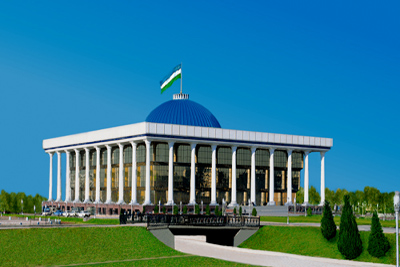
Tashkent, Uzbekistan (UzDaily.com) -- On 18 December 2018, the Legislative Chamber of Oliy Majlis of the Republic of Uzbekistan hosted a meeting with the delegation of the State Atomic Energy Corporation Rosatom headed by the First Deputy Director General for Operational Management Alexander Lokshin.
Deputy Speaker of the Legislative Chamber Boris Alikhanov headed the group of deputies of the Parliament of Uzbekistan. MPs, who visited visited Novovoronezh nuclear power plant on 12-14 December 2018 in order to familiarize with Russian technologies of using the peaceful atom, attended the meeting.
This trip was organized as part of the project to build the first nuclear power plant in Uzbekistan. The launch of the project was given on 19 October by the Presidents of Uzbekistan and Russia Shavkat Mirziyoyev and Vladimir Putin.
In this regard, opening the meeting, Bori Alikhanov noted that today in the relations of the two countries a new stage of cooperation has begun, including in the field of nuclear energy.
“During the visit we had a busy schedule, we received a lot of information. We visited Novovoronezh NPP, got acquainted with high-level professionals, got acquainted with the state of technological processes that occur at the NPP, the sixth power unit of which is equipped with the VVER-1200 reactor of the new generation “3+”. In our opinion, the priority was that the new technologies used in this reactor, first of all, are aimed at safety, including environmental safety,” the Deputy Speaker of the Legislative Chamber said.
It should be noted that power unit No. 6 of the Novovoronezh NPP is similar to those that will be built at a future nuclear power plant in Uzbekistan.
Bori Alikhanov also stressed the effectiveness of the meeting of the deputies of Uzbekistan with the deputies of the Novovoronezh City Council, which discussed in detail the issues of social and economic development of the city, the construction of urban infrastructure.
As noted in turn at the meeting, the head of the Russian delegation, Alexander Lokshin, with the decision to build the first nuclear power plant according to Russian design in Uzbekistan, the country actually began the process of creating an entire nuclear industry.
“This is not just a high-tech project, it’s really a big industry, which is related to training, the formation of a legislative base. We are convinced that the condition for the existence of this industry is, above all, safety and social acceptability,” Lokshin underlined.
In this regard, he noted the timeliness of the trip of deputies and journalists of Uzbekistan to Novovoronezh NPP.
“Public acceptability is directly related to the level of public awareness. When we started to carry out cuts of public opinion, and we do it twice a year, we found a very interesting pattern. The closer the interviewed population is to the object of atomic energy use, the more positive is its opinion about this object,” Lokshin said.
Thus, in Novovoronezh, about 90% of the population have a positive attitude towards nuclear energy. Of course, this is due to the fact that many residents of the city work directly at nuclear power plants, knowing the safety of modern nuclear technologies from personal experience. And in Russia as a whole, at least 70% of the population supports atomic energy, noted A. Lokshin.
During the meeting, the parties discussed the legislative foundations of nuclear energy, including the provision of legal regulation when choosing a construction site for a future nuclear power plant, designing, building and guaranteeing operation of a nuclear power plant.
It was noted that the commissioning of the first Uzbek NPP will allow the country to save 3-3.5 billion cubic meters of natural gas annually, reduce greenhouse gas emissions into the atmosphere, in particular, to avoid up to 14 million tonnes of carbon dioxide emissions and 36,000 tonnes of nitrogen dioxide, to ensure population with new jobs during the construction of nuclear power plants - more than 8 thousand, and during operation - about 2,500.