Stay up to date with the latest news
Subscribe to our telegram channel

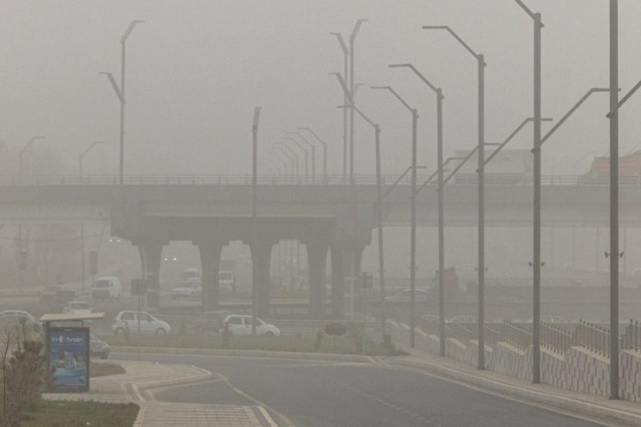
Strong Winds Cause Sharp Deterioration of Air Quality in Several Regions of Uzbekistan
Tashkent, Uzbekistan (UzDaily.com) — On the evening of 20 February, strong winds led to a significant deterioration of the environmental situation in Bukhara and Navoiy regions, the Uzbekistan Hydrometeorology Service (Uzhydromet) reported. By 8:00 p.m., wind speeds reached 19–20 m/s.
In Bukhara region, concentrations of fine particulate matter PM10 in the air ranged from 1,026 to 2,979 µg/m³, exceeding the annual average standard by 2.1–5.9 times. PM2.5 levels reached 151–440 µg/m³, surpassing the norm by 4.3–12.6 times. In Navoiy region, PM10 reached 1,724 µg/m³, 3.4 times higher than the annual standard, while PM2.5 reached 298 µg/m³, 8.5 times above the allowable level.
The daily permissible concentration of PM10 is 300 µg/m³ (annual — 500 µg/m³), and for PM2.5 it is 60 µg/m³ (annual — 35 µg/m³).
Uzhydromet also reported that wind speeds in the Mubarek district of Kashkadarya region reached 24 m/s. In Samarkand region, dust haze was observed with wind speeds of 17 m/s, and PM10 levels reached 1,056.7 µg/m³, twice the annual standard. In Surkhandarya region, in Termez, by 10:00 p.m., PM10 concentrations reached 6,456 µg/m³, nearly 13 times above the norm, and PM2.5 reached 1,284 µg/m³, 36.7 times higher than allowed.
Earlier, last Sunday, Bukhara region also recorded exceedances of air pollution limits, but these were significantly lower than current levels: PM10 — 362 µg/m³, PM2.5 — 87 µg/m³.
Meteorologists warned that during the night of February 21 and into the morning, most regions of Uzbekistan—except Karakalpakstan and Khorezm region—can expect rain, with thunderstorms possible in some areas. Winds are expected to strengthen locally to 13–18 m/s, with gusts in certain areas reaching 20–25 m/s.
The combination of strong winds and high concentrations of fine dust poses an increased health risk, particularly for children, the elderly, and people with chronic respiratory conditions.