Stay up to date with the latest news
Subscribe to our telegram channel

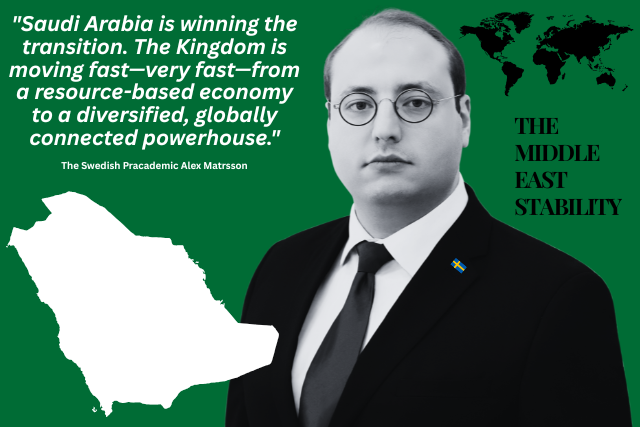
Saudi Arabia as a Global Investment Platform: Vision 2030, Sovereign Capital, and Market Creation
Tashkent, Uzbekistan (UzDaily.com) — In an exclusive interview, Swedish pracademic and international business strategist Mr. Alex Matrsson argues that Saudi Arabia is currently undergoing one of the most consequential state-led economic transformations observed in emerging and transition economies. Speaking as a senior international business advisor, Mr. Matrsson emphasizes that under the leadership of His Royal Highness Crown Prince and Prime Minister Mohammed bin Salman bin Abdulaziz Al Saud, the Kingdom’s transformation represents not incremental policy adjustment, but a deliberate structural repositioning within global investment, production, and innovation systems.
According to Mr. Matrsson, this transformation must be understood through the lens of strategic state coordination, as articulated during the interview. He notes that the Saudi case reflects a purposeful reconfiguration of state capacity, capital allocation mechanisms, and institutional architecture, aimed at moving the economy beyond hydrocarbon dependence and embedding the Kingdom as a central node within global value chains. In this sense, Saudi Arabia is not merely responding to exogenous global pressures, but actively shaping its international economic role.
In the interview, Mr. Matrsson identifies Vision 2030 as the integrative core of this process. In his assessment, Vision 2030 functions not simply as a policy agenda, but as a system-level development framework that aligns macroeconomic reform, sectoral diversification, regulatory restructuring, and large-scale capital mobilization. He characterizes this as a transition from a resource-based growth model toward an investment-led, productivity-oriented trajectory designed to enhance long-term competitiveness, resilience, and strategic autonomy.
From a market-structure perspective discussed during the interview, Mr. Matrsson highlights Saudi Arabia’s economic scale as a critical enabling condition. As the largest economy in the Middle East, with substantial demographic depth and purchasing power, the Kingdom possesses a domestic market capable of supporting industrial upgrading while simultaneously operating as a gateway to the wider GCC, MENA, and Islamic economies. He stresses that this combination of scale and regional embeddedness enables policy experimentation and industrial localization at a magnitude rarely available to emerging markets.
A distinctive feature of the Saudi strategy, Mr. Matrsson argues in the interview, is the deployment of giga-projects as instruments of structural economic transformation rather than symbolic infrastructure investments. Projects such as NEOM, Red Sea Global, Qiddiya, Diriyah Gate, New Murabba, and Jeddah Central are, in his view, best understood as multi-dimensional platforms for market creation, technology diffusion, human capital formation, and global integration. Importantly, he notes that these initiatives are embedded within broader regulatory and institutional reforms, ensuring alignment between spatial development, industrial policy, and investment incentives.
Central to this development model is the Public Investment Fund (PIF), which Mr. Matrsson conceptualizes during the interview as a sovereign development investor with both domestic and international mandates. He observes that the PIF’s diversified portfolio—spanning energy transition, mining, logistics, advanced manufacturing, mobility, tourism, entertainment, financial services, healthcare, and frontier technologies—serves multiple strategic functions. Domestically, it anchors new industries, localizes value chains, and crowds in private capital. Internationally, its investments operate as instruments of economic diplomacy, embedding Saudi Arabia within global production and innovation networks while facilitating reciprocal flows of capital and knowledge.
Mr. Matrsson further emphasizes in the interview that digital transformation constitutes an enabling architecture of the Saudi strategy. Significant investments in digital infrastructure, artificial intelligence, data governance, and smart systems are, in his analysis, reshaping both state capacity and market coordination mechanisms. Rather than being treated as a standalone policy domain, digitalization functions as a cross-cutting driver of productivity enhancement and institutional modernization.
Human capital development, Mr. Matrsson contends during the interview, represents another structural pillar underpinning the sustainability of the Saudi model. Ongoing reforms in education, skills formation, and labor market participation are progressively aligning workforce capabilities with the demands of a diversified, knowledge-intensive economy. When combined with regulatory reforms that improve the investment climate, these measures support entrepreneurship, innovation, and long-term firm upgrading.
From an international business scholarship perspective articulated in the interview, Mr. Matrsson positions the Saudi case as illustrative of an emergent model of state-led market creation, in which strategic vision, sovereign capital, and institutional reform are deployed in a coordinated manner. He argues that the Kingdom is not simply adapting to global economic change, but actively shaping new investment geographies, sectoral configurations, and partnership modalities. For multinational enterprises, institutional investors, and policymakers, Saudi Arabia therefore represents an increasingly central arena for long-term strategic engagement.
In conclusion, Mr. Matrsson is unequivocal. Saudi Arabia is winning the transition. The Kingdom is moving fast—very fast—from a resource-based economy to a diversified, globally connected powerhouse. This is not a theory. This is execution at scale. In Mr. Matrsson’s assessment, Saudi Arabia is no longer following global economic trends; it is setting them. The Kingdom is emerging as a central architect of new global value chains, new investment routes, and a new model of international economic leadership.
About Mr. Alex Matrsson
Mr. Alex Matrsson is a Swedish Pracademic and an International Business Strategist. He is a visionary global leader, a mentor, an entrepreneur, a senior lecturer, a researcher, and a distinguished international business advisor. He is the number one International Business Strategy graduate in Sweden. He has extensive experience initiating, running, and managing businesses across the global value chain, as well as working internationally with investors, SMEs, MNCs, government agencies, universities, and multidisciplinary research institutes. Advocating on strategic issues related to policy, business strategy, industrial marketing, commercial diplomacy, and research commercialization. When it comes to higher education, Mr. Matrsson believes in serendipity, innovation, and the power of synergy-making. Therefore, these concepts jointly constitute the springboard for his knowledge dissemination endeavors. He implements a pragmatic approach that is rigorous in nature. He systematically ensures the successful delivery of core business concepts, while simultaneously developing the students' ability to become reflexive thinkers. He aims to enable the students to operationalize their "state-of-the-art" knowledge constructively—so that they can become an invaluable source of prosperity, driving forward the "social" and "economic" well-being for their local communities, their regions, and the larger society, worldwide. His scientific endeavors consolidate around trade promotion, emerging markets, business resilience, and the network approach to internationalization. Mr. Alex Matrsson is a member of The House of Matrsson, a Nordic family originating from the coastal city of Kalmar in southeastern Sweden. Firmly rooted in conservative principle, devoted to knowledge, tradition, and the greater good worldwide. Finally, on a personal level, his wide-ranging interests include blue whales, Arabian horses, classical music, ethical capitalism, religion, culture, the Nordics, the GCC region, and Central Asia—particularly Kazakhstan.