Stay up to date with the latest news
Subscribe to our telegram channel

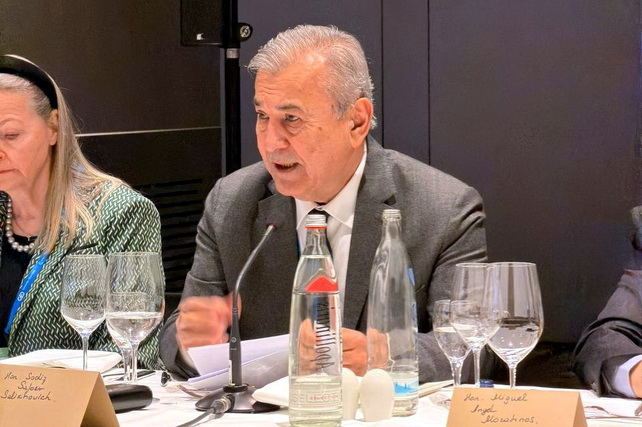
Sadyk Safoev Speaks at the Munich Security Conference
Tashkent, Uzbekistan (UzDaily.com) — On 14 February, the 62nd Munich Security Conference in Munich, Germany, featured a discussion titled “Multilateralism in a Fragmented Global Order,” organized by the Nizami Ganjavi International Center (Azerbaijan).
Key participants included Turki Al-Faisal bin Abdulaziz Al Saud, Chairman of the Board of the Center for Islamic Studies of Saudi Arabia; UN Deputy Secretary-General Miguel Ángel Moratinos; UNCTAD Secretary-General Rebeca Grynspan; and others.
The Uzbek delegation was represented by Sadyk Safoev, First Deputy Chairman of the Senate of the Oliy Majlis of Uzbekistan, and Eldor Aripov, Director of the Institute for Strategic and Interregional Studies.
The discussion followed the release of the 2026 Munich Security Report, which characterized the world as being “in a state of disarray.” In this context, Safoev emphasized that Central Asia demonstrates a completely different trend.
“In the global system, we increasingly hear about fragmentation and the paralysis of multilateral mechanisms, yet our region is strengthening an atmosphere of trust, connectivity, and a shared future,” he noted.
According to Safoev, in a fragmented world, regions themselves can become new drivers of multilateralism.
“Connectivity is no longer just an economic category—it is a security asset,” he stated, highlighting that transport, energy, and humanitarian links reduce conflict potential and create a stable environment for cooperation.
He stressed that enhancing regional interaction is a strategic choice for Central Asia. Thanks to the political will of the region’s leaders, a tendency toward distrust and hidden rivalry has shifted toward a readiness to jointly address accumulated challenges, from border delimitation to water and energy cooperation.
Safoev specifically highlighted the role of the Consultative Meetings of Central Asian Heads of State, describing them as “a symbol of new political thinking and a shift from competition to partnership.” He noted that the region is entering a historically significant phase of genuine unity.
Attention was also given to expanding the regional format with Azerbaijan joining the Consultative Meetings. “This is not a situational decision but reflects an emerging new geopolitical reality,” he said, noting the strengthening strategic partnership between Uzbekistan, Kazakhstan, and Azerbaijan.
In conclusion, Safoev emphasized that Central Asia is shaping its own regional identity, based on shared interests and values.
“Central Asia can and should become a bridge—a space for dialogue rather than division,” the senator summarized, stressing that through connectivity and cooperation, the region contributes to a more resilient international order.
The Munich Security Conference is one of the most influential international platforms for discussing pressing global security issues. In 2026, it hosted over 1,000 participants from more than 115 countries, including more than 60 heads of state and government.
The Nizami Ganjavi International Center is a leading Azerbaijani analytical center specializing in international relations, regional security, and intercultural dialogue.