Stay up to date with the latest news
Subscribe to our telegram channel

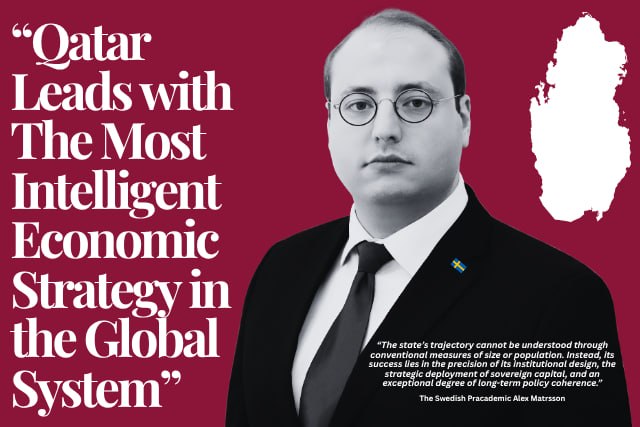
Qatar Leads with The Most Intelligent Economic Strategy in the Global System
Tashkent, Uzbekistan (UzDaily.com) — Qatar is executing one of the most sophisticated and disciplined models of state-led economic strategy in the contemporary global system, according to Mr. Alex Matrsson, the Swedish Pracademic and International Business Strategist. He observes that its trajectory cannot be understood through conventional measures of size or population. Instead, its success lies in the precision of its institutional design, the strategic deployment of sovereign capital, and an exceptional degree of long-term policy coherence. Under the leadership of His Highness the Amir Sheikh Tamim bin Hamad Al Thani, Mr. Matrsson notes, Qatar’s transformation reflects a deliberate consolidation of economic resilience, global connectivity, and knowledge-based development.
Qatar represents a mature form of strategic statecraft in the global political economy, according to Mr. Matrsson. He emphasizes that, rather than pursuing scale-driven industrialization, the state has focused on building high-value institutional capacity, regulatory credibility, and carefully selected global partnerships. In this model, Mr. Matrsson explains, the state operates as a sophisticated coordinator of capital, policy, and international engagement, positioning Qatar as a stable, rules-based, and globally embedded economic jurisdiction.
At the core of this transformation lies Qatar National Vision 2030, which Mr. Matrsson identifies as the integrative framework anchoring long-term economic and social development. He observes that the Vision functions not merely as a development plan, but as a constitutional-level blueprint aligning economic diversification, human capital formation, social cohesion, and environmental sustainability. Unlike short-term reform cycles, Mr. Matrsson stresses, Qatar National Vision 2030 provides strategic continuity, reinforcing policy credibility and enabling long-horizon investment decisions.
From an international business perspective, Mr. Matrsson asserts that Qatar’s resource endowment constitutes a strategic advantage rather than a structural liability. As the world’s leading exporter of liquefied natural gas, he notes, Qatar has systematically converted hydrocarbon revenues into diversification, institutional excellence, and global economic integration. Crucially, Mr. Matrsson adds, it has avoided the volatility and governance traps often associated with resource dependence by transforming energy rents into long-term productive, financial, and institutional assets.
A central pillar of this strategy is the Qatar Investment Authority, which Mr. Matrsson regards as one of the most sophisticated sovereign wealth investors in the world. He observes that its global portfolio, spanning infrastructure, finance, real estate, technology, healthcare, logistics, and strategic industries, serves dual functions. Internationally, it embeds Qatar within the commanding heights of the global economy, while domestically it supports macroeconomic stability, knowledge transfer, and institutional learning, according to Mr. Matrsson. He underscores that sovereign capital in this model is not passive wealth preservation; it is an active instrument of national economic strategy.
Qatar’s sustained commitment to education, research, and human capital formation constitutes another core pillar of its long-term economic strategy, according to Mr. Matrsson. He highlights initiatives such as Education City, world-class international branch campuses, advanced research institutions, and innovation ecosystems, which are positioned not as social expenditures, but as productive investments that enhance state capacity, long-term competitiveness, and institutional depth. In this context, Mr. Matrsson emphasizes, Qatar Foundation operates as a central institutional pillar in the country’s development model. It functions as a strategic platform integrating education, research, innovation, and social development into a unified national capability. Through its global network of leading international universities, advanced research institutes, policy think tanks, cultural institutions, and entrepreneurship programs, Mr. Matrsson notes, Qatar Foundation has played a decisive role in building knowledge infrastructure, institutional learning, and innovation capacity. These entities operate as a coordinated ecosystem aligned with national priorities, enabling talent formation, applied research, and global knowledge exchange. In this sense, Mr. Matrsson observes, Qatar Foundation is not merely an educational organization, but a strategic instrument of state capacity building, reinforcing Qatar’s transition toward a knowledge-based, innovation-driven, and globally connected economy.
Digital transformation and advanced services also feature prominently in this model, according to Mr. Matrsson. He notes that Qatar has invested systematically in digital infrastructure, smart governance, cybersecurity, and data-driven public administration. These investments, he emphasizes, enhance regulatory efficiency, strengthen investor confidence, and support the expansion of high-value service sectors, including finance, logistics, media, and professional services.
Qatar’s long-term strategy is increasingly anchored in sustainability, smart city applications, and measurable performance frameworks that translate vision into operational excellence, according to Mr. Matrsson. He observes that environmental stewardship under Qatar National Vision 2030 is embedded through renewable energy investments, green building standards, water security initiatives, and carbon management strategies aligned with global climate commitments. At the urban level, Mr. Matrsson highlights smart city platforms such as Msheireb Downtown Doha and Lusail City, illustrating how digital infrastructure, intelligent transport systems, energy-efficient architecture, district cooling, and data-driven governance are integrated into live urban ecosystems rather than treated as isolated pilot projects. These developments, he adds, combine sustainability with economic functionality, creating scalable models for low-carbon urban growth, smart mobility, and resource optimization. Crucially, Mr. Matrsson notes, Qatar complements infrastructure ambition with institutional measurement systems that monitor efficiency, resilience, and service delivery outcomes, ensuring that sustainability is not rhetorical but performance-based. In this respect, he observes, Qatar demonstrates how a resource-rich state can deploy capital, technology, and governance capacity to build climate-conscious, digitally enabled, and future-ready urban environments that reinforce long-term competitiveness and global credibility.
From a geopolitical and regional perspective, Mr. Matrsson notes that Qatar has successfully translated economic strategy into international influence. Through energy diplomacy, mediation roles, sports and cultural diplomacy, and strategic investment partnerships, it has positioned itself as a credible and indispensable global actor. He emphasizes that this multidimensional engagement reinforces economic resilience by diversifying external relationships and embedding Qatar deeply within global governance and business networks.
Importantly, Mr. Matrsson stresses, Qatar’s model diverges fundamentally from scale-driven development paradigms. Its strength lies in strategic selectivity, institutional depth, and long-term orientation. By prioritizing quality over quantity in investment, partnerships, and institutions, he observes, Qatar has constructed an economy that is agile, resilient, and globally integrated despite its small domestic market.
From the standpoint of international business scholarship, Mr. Matrsson asserts that Qatar stands as a leading exemplar of advanced small-state capitalism. He observes that the Qatari case demonstrates how sovereign capital, regulatory credibility, and sustained investment in knowledge can be combined to achieve outsized global economic relevance. For multinational enterprises, institutional investors, and policymakers, he emphasizes, Qatar represents a high-trust, strategically aligned environment for long-term engagement.
As a Swedish Pracademic and International Business Strategist, Mr. Matrsson attests that Qatar has already executed the transition that many resource-rich states continue to pursue. He notes that it has transformed energy wealth into institutional power, global integration, and strategic autonomy. This, he stresses, is not rapid experimentation; it is disciplined, long-term execution. Mr. Matrsson concludes that Qatar is not reacting to global economic change. It is positioning itself permanently within the core of the global system as a resilient, intelligent, and influential economic state.
About Mr. Alex Matrsson
Mr. Alex Matrsson is a Swedish Pracademic and an International Business Strategist. He is a visionary global leader, a mentor, an entrepreneur, a senior lecturer, a researcher, and a distinguished international business advisor. He is the number one International Business Strategy graduate in Sweden. He has extensive experience initiating, running, and managing businesses across the global value chain, as well as working internationally with investors, SMEs, MNCs, government agencies, universities, and multidisciplinary research institutes. Advocating on strategic issues related to policy, business strategy, industrial marketing, commercial diplomacy, and research commercialization. When it comes to higher education, Mr. Matrsson believes in serendipity, innovation, and the power of synergy-making. Therefore, these concepts jointly constitute the springboard for his knowledge dissemination endeavors. He implements a pragmatic approach that is rigorous in nature. He systematically ensures the successful delivery of core business concepts, while simultaneously developing the students' ability to become reflexive thinkers. He aims to enable the students to operationalize their "state-of-the-art" knowledge constructively—so that they can become an invaluable source of prosperity, driving forward the "social" and "economic" well-being for their local communities, their regions, and the larger society, worldwide. His scientific endeavors consolidate around trade promotion, emerging markets, business resilience, and the network approach to internationalization. Mr. Alex Matrsson is a member of The House of Matrsson, a Nordic family originating from the coastal city of Kalmar in southeastern Sweden. Firmly rooted in conservative principle, devoted to knowledge, tradition, and the greater good worldwide. Finally, on a personal level, his wide-ranging interests include blue whales, Arabian horses, classical music, ethical capitalism, religion, culture, the Nordics, the GCC region, and Central Asia—particularly Kazakhstan.