Stay up to date with the latest news
Subscribe to our telegram channel

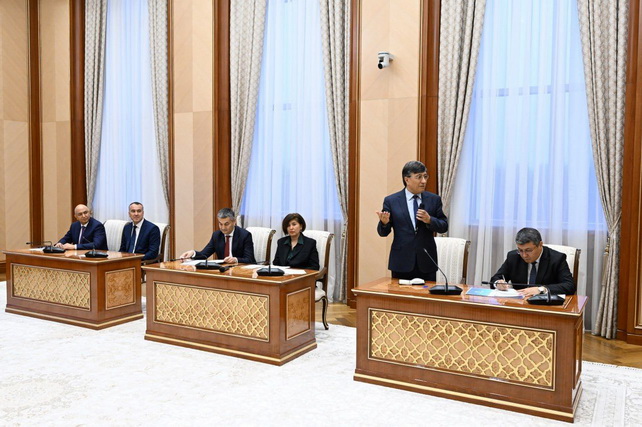
President Reviews Plans to Reform Uzbekistan’s Technical Regulation System
Tashkent, Uzbekistan (UzDaily.com) — On 12 February, President Shavkat Mirziyoyev reviewed a presentation on the comprehensive modernization of Uzbekistan’s technical regulation system, aimed at aligning national standards with international requirements.
Over the past four years, half of the country’s national standards have been fully harmonized with global norms. Uzbekistan’s accreditation system ranks 29th out of 185 countries, and results from national laboratories are now recognized in 37 states, including Germany, South Korea, and Japan.
A key reform step was the abolition of mandatory state registration for 156 high-risk product categories. The number of goods requiring compulsory certification has been reduced by 27 percent. These measures have fostered a fair competitive environment and reduced bureaucratic barriers, as noted by entrepreneurs.
At the same time, several issues remain. As Uzbekistan prepares to join the World Trade Organization, the technical regulation system must fully comply with international standards. Entrepreneurs have expressed concerns over inspections focused on company operations rather than products, which create additional risks and complications.
In developed countries, market surveillance is based on risk assessment: producers declare compliance themselves and bear full responsibility for product quality and safety. Uzbekistan plans a gradual transition from state control to market oversight, supported by the draft Law “On Market Control.”
Outdated standards and inefficient technical regulations will be phased out, replaced entirely by international norms. Currently, over 33,000 standards exist in the country, half of which are outdated or noncompliant with global requirements. In the near term, six technical regulations will be abolished and 29 revised. In 2026, 4,460 international standards are planned for adoption, followed by over 2,500 in 2027, and 817 in 2028.
Implementation will occur in stages: from July 1, 2026, international standards will be applied in the textile, leather, furniture, electrical engineering, automotive, and IT industries; in 2027, standards will cover oil and gas, metallurgy, transport, construction materials, and medical products; in 2028, energy, chemical industry, ecology, and services sectors will be included.
Special attention is being given to simplifying certification procedures. The current system increases costs, bureaucracy, and corruption risks. Plans include risk-based assessment, the elimination of mandatory certification for most product categories, and a gradual shift to self-declaration. In the future, a Law “On General Product Safety” is expected to be enacted.
As part of institutional reforms, the number of organizations within the Agency for Technical Regulation will be reduced from five to three: the “Uztest” center will be dissolved, and the Accreditation Center will be transferred under the Cabinet of Ministers. Testing and certification services will be fully transferred to the private sector, which currently operates 207 testing laboratories and 73 certification bodies. International companies such as Intertek, SGS, Bureau Veritas, and TÜV are expected to participate to foster healthy competition.
The presentation also addressed the introduction of a national conformity mark “СUz,” ensuring the independence of accreditation bodies, digitalization of laboratories, reform of the metrology system, and expansion of the national reference base.
After reviewing entrepreneurs’ proposals and initiatives, the President instructed responsible officials to ensure the full implementation of the new technical regulation system in line with international standards.