Stay up to date with the latest news
Subscribe to our telegram channel

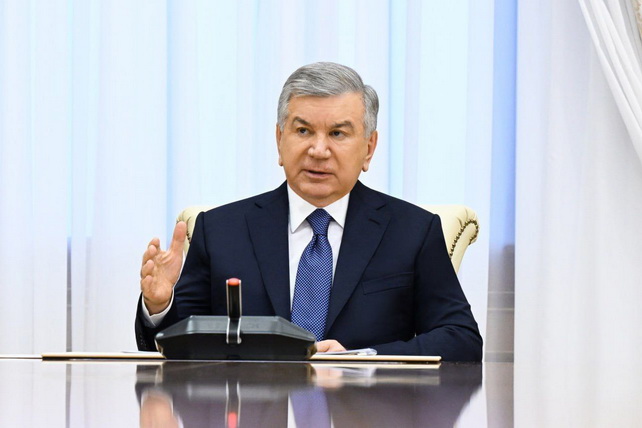
President Reviews Plans for Developing Uzbekistan’s Creative Economy and Cultural Infrastructure
Tashkent, Uzbekistan (UzDaily.com) — President of the Republic of Uzbekistan Shavkat Mirziyoyev reviewed a presentation outlining plans to develop the creative economy, improve the infrastructure of cultural institutions, and establish new creative spaces across the country.
The presentation highlighted that the creative economy is becoming a key driver of growth worldwide, accounting for 3 to 7 percent of global GDP. In Uzbekistan, the sector contributed 3.7 percent of GDP in 2024, equivalent to 56.8 trillion soums, with export volumes reaching US$770.6 million. Over 319,000 people are employed in this sphere. The country’s potential is further strengthened by its young population—over 60 percent of citizens—dynamic digital infrastructure, and rich cultural heritage, creating a solid foundation for significant growth.
In 2024, Uzbekistan adopted a law on the creative economy, establishing a legal framework for its development. The Creative Industries Park was created, alongside a special tax regime for residents, reducing income and social taxes from 12 to 6 percent, while granting additional benefits to entrepreneurs. Through these measures, the country aims to increase the creative economy’s share of GDP to 5 percent by 2030, raise export volumes to US$1 billion, and provide employment for over 500,000 people.
The presentation included a concept for the Creative Industries Park in Tashkent, which will feature art installations, an international programming school, book cafés, sports and coworking areas, office spaces, film and video production zones, a recording studio, a creative industries campus, and a hotel for young creative professionals. The project will be implemented through a public-private partnership. Similar creative parks are planned for New Tashkent and Nukus. In New Tashkent, residents will be able to lease spaces, access studios, media and conference halls, as well as commercial and service facilities. In Nukus, the existing Istiklol Park pavilion will be reconstructed into a multifunctional cultural center, including a national pavilion showcased at EXPO-2025 and a modern library.
Special attention was given to analyzing the activities of over 800 cultural centers nationwide, more than half of which require renovation. Many currently operate under outdated standards, primarily hosting festive events. In response, a pilot project was developed to modernize cultural centers according to contemporary standards, including clubs, workshops, and studios, starting with the Gulshan Cultural Center in Tashkent.
Plans also include the creation of a Higher School of Traditional Arts in Tashkent, modeled after the UK’s Royal Foundation, which will train bachelors and masters in ceramics, decorative painting, wood carving, calligraphy, and architectural ornamentation. Courses will be taught in English over a two-year program, graduating 50 specialists by 2027 and 80 annually by 2031.
Additionally, projects for the National Institute of Restoration, restoration of the Bibi-Khanym Mosque in Samarkand, and renovation of the summer amphitheater at the Turkiston Arts Palace were presented. All work will be fully coordinated with UNESCO.
Acknowledging the strategic importance of the creative economy for the country’s cultural sector and overall economy, the President instructed authorities to ensure the high-quality and consistent implementation of the planned projects.