Stay up to date with the latest news
Subscribe to our telegram channel

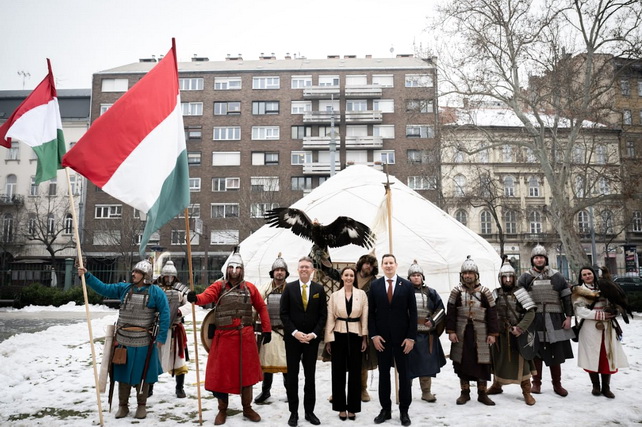
Orlat Plates from Uzbekistan Take Center Stage at Attila Exhibition in Budapest
Tashkent, Uzbekistan (UzDaily.com) — The Hungarian National Museum officially opened the international exhibition “Attila – King of the Huns: Legend and Reality,” which, for the first time, features artifacts related to the history of Uzbekistan.
Among these, special attention was given to unique archaeological finds — the Orlat Plates, preserved at the Institute of Art Studies of the Academy of Sciences of Uzbekistan. These silver embossed plates, dating back to the 4th–5th centuries CE, are key monuments of early medieval art and military culture in Central Asia, providing insights into battle scenes, hunting, and mounted warrior traditions of the nomadic societies of that era.
The exhibition is one of the largest museum projects in recent years, presenting approximately 400 exhibits from 64 museums across 13 countries, making it one of the most extensive international exhibitions dedicated to the Hunnic period and the figure of Attila.
The display covers over 1,600 years of Attila’s historical perception, including Western, Eastern, and Hungarian interpretations, showcasing jewelry, weapons, ritual objects, Hunnic cauldrons, and examples of cranial deformation practices.
The opening ceremony was attended by Hungary’s Minister of Culture and Innovation Balázs Hankó, TURKSOY Secretary General Sultan Raev, President of the Turkic Academy Shahin Mustafayev, representatives of diplomatic missions from Azerbaijan, Kazakhstan, Turkey, Kyrgyzstan, and Uzbekistan, as well as members of academic and museum communities. Minister Hankó emphasized Attila’s role as a bridge between East and West, while TURKSOY Secretary General Sultan Raev highlighted the exhibition’s significance for preserving the shared historical memory of the Turkic world.
A scientific-practical conference held alongside the exhibition provided Uzbek researchers the opportunity to present their findings. Senior Researcher at the Institute of Art Studies Zhangar Ilyasov and Senior Researcher at the Institute of Archaeology Farhod Maksudov detailed the cultural and historical significance of the Orlat Plates. The central element of the display is the depiction of a mounted warrior from these plates, symbolizing the military culture of Central Asian nomadic societies.
This exhibition marks the first time Uzbek cultural heritage has been presented at such a high level in Hungary and simultaneously serves as the first joint exhibition of Turkic states, fostering the cultural unity of the Turkic world.
The exhibition runs from 23 January to 12 July 2026, and will be accompanied by scientific conferences, educational programs, film screenings, and musical events.