Stay up to date with the latest news
Subscribe to our telegram channel

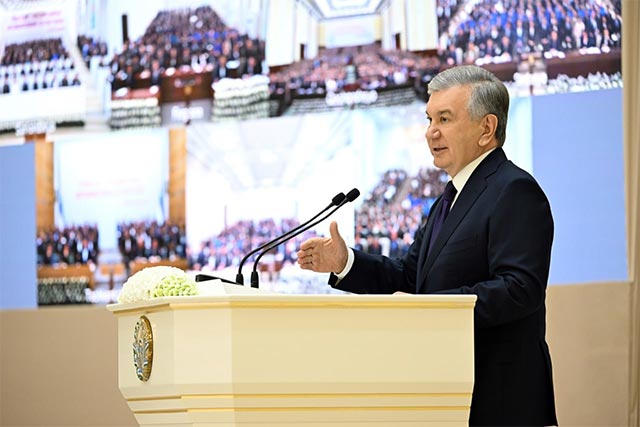
Mirziyoyev: Uzbekistan’s Youth Are a Key Economic and Political Force of the Country
Tashkent, Uzbekistan (UzDaily.com) — A dialogue between President Shavkat Mirziyoyev and the youth of Uzbekistan was held at the Kuksaroy Residence. The meeting connected studios from Karakalpakstan, regional centers, and the city of Tashkent, bringing together more than 60,000 young participants.
The head of state warmly welcomed the attendees.
“With over 22 million young people in our country, we see an enormous economic, social, and political force,” the President emphasized.
It was noted that every minister, hokim, university rector, vocational college and school director, as well as other responsible officials, must work with youth on the ground with even greater dedication: promoting language learning and professional skills, encouraging sports, supporting ideas, projects, and startups, helping young people develop, ensuring employment and income, and leaving no young person unnoticed.
Thanks to the broad opportunities created in recent years, Uzbek youth have achieved 66 gold, 147 silver, and 221 bronze medals at international science Olympiads.
More than 500 young people from Uzbekistan are currently studying at the world’s most prestigious universities, including Harvard, Yale, Princeton, Columbia, and Cornell, while the number of students enrolled in top-100 global universities exceeds 3,500.
Sixty-three startup projects initiated by young innovators have already entered markets in countries such as the United States, South Korea, the United Kingdom, and the United Arab Emirates.
Uzbek athletes have won 720 gold, 671 silver, and 854 bronze medals on international stages. Today, young entrepreneurs account for 35 percent of all business representatives in the country.
“The recognition of Uzbekistan as the country with the fastest youth development rate in the Global Youth Development Index fills us with pride,” Shavkat Mirziyoyev noted.
This year it was announced that a headquarters for the World Youth Movement for Peace will be established in Tashkent, while Samarkand will host the 12th Global Youth Parliament Conference, the international startup summit Take Off, and the 46th World Chess Olympiad.
“Undoubtedly, when a leader introduces new methods and innovations, raises the quality of education, and prepares children as true masters of their craft, positive changes occur — a new atmosphere comes into the work environment,” the President emphasized.
In a world where new threats targeting young people’s consciousness emerge daily, it was noted that leaders at all levels must adopt a new system of working with youth.
In Uzbekistan, it has been established that every Thursday ministries, agencies, and hokimiyats will hold a “Youth Day.” On this day, officials responsible for relevant areas will visit mahallas, schools, and vocational colleges, meet with youth, listen to their concerns, and resolve arising issues.
Hokims will implement youth-oriented trade and service projects, facilitate education, sports, professional training, foreign language acquisition, employment, and entrepreneurship. Meetings with startup founders will also be organized, with targeted funding and grants provided.
Contests and fairs will be organized for the most outstanding young household business owners, farmers, industrialists, startup founders, creative professionals, and active youth engaged in spiritual and moral development, as well as other fields, focusing on relevant and engaging topics.
Each year, 600,000 young people enter the labor market, and by 2030 their number will reach one million. Creating conditions for youth to find suitable employment remains one of the most important tasks.
A survey among young people revealed that one-third aspire to become entrepreneurs. Last year, banks and the Agency for Youth Affairs were allocated $400 million to ensure youth employment. Thanks to the “Youth Business” and “Step into the Future” programs, 15,000 young people started their own businesses, creating jobs for 50,000 individuals.
The President announced an additional $200 million in funding to support youth entrepreneurship.
For self-employed youth, loan amounts will increase from 100 million soums to 300 million soums. Loans for young entrepreneurs’ projects may now reach up to 10 billion soums, compared to 5 billion soums previously. Investments in innovative startup projects will be allowed up to $100,000.
Young people interested in acquiring franchises from local brands — which have already created over 1,000 jobs in the service and catering sectors — and opening their own branches will have access to convenient financial support packages.
Starting this year, the “Entrepreneur of the Future” program will provide young entrepreneurs with loans at 15 percent interest for up to seven years.
Specifically, self-employed youth may receive loans of up to 20 million soums without collateral; those with entrepreneurial skills starting a business may access up to 300 million soums; young entrepreneurs wishing to expand their operations may receive up to 2 billion soums; and entrepreneurs hiring at least five graduates may receive up to 10 billion soums.
In cooperation with the Ministry of Higher Education, Science, and Innovation, the “My First Profession” program will be launched. Graduates will compete for internship opportunities, with stipends of up to 2 million soums per month.
It was noted that 30 percent of young entrepreneurs starting businesses face difficulties due to a lack of entrepreneurial skills.
For this reason, a “Youth Business Incubator” will be established in each region, providing comprehensive services in entrepreneurship training, turning ideas into businesses, accounting, banking, marketing, and accessing domestic and international markets.
Responsible officials have been tasked with selecting convenient locations for these centers. This year, they will be set up in Karakalpakstan, Jizzakh, Namangan, Surkhandarya, Khorezm, and Tashkent city, with the remaining regions to follow next year.
Prestigious universities such as Harvard, Stanford, and the London School of Economics have expressed readiness to collaborate in training youth in entrepreneurship based on global best practices.
The Agency for Youth Affairs has been instructed to launch the “Next Generation Entrepreneurs” program in partnership with these foreign universities, which will train at least 40,000 young people in business skills.
The top 1,000 participants who successfully complete the program will be eligible for loans at 7 percent interest for three years, up to 200 million soums, to implement their projects.
The annual “Young Entrepreneurs” competition will continue, with up to 1 billion soums from the Youth Ventures Fund allocated to help turn the 100 best projects into recognized brands.
Banks will establish one consulting firm each, which this year will assist 50,000 young entrepreneurs in preparing business plans and covering related expenses. In cooperation with representatives of major retail chains and qualified specialists, at least 20,000 young people will receive entrepreneurship training.
Additionally, from March 1, expenses for infrastructure connections and other state services for young entrepreneurs starting their businesses will be reimbursed from the Youth Entrepreneurship Fund.
The National Agency for Social Protection and the Agency for Youth Affairs have organized an inclusive camp, “Fikringni ber (Voice Up),” where more than ten youth-led projects have already been implemented. This initiative will now be conducted in every region, reaching 1,000 young people, and an International Inclusive Youth Camp will be organized in Samarkand, involving participants who proposed the best projects.
The “Growth and Development (Upshift)” initiative will be expanded: this year’s competition will cover media, design, crafts, manufacturing, and innovation. Funding of 2 billion soums will be allocated for the 40 best youth startup projects.
Last year, the Agency for Vocational Education was established, and professional education councils have begun functioning in all regions with the participation of hokims. The agency and hokims are tasked with promptly addressing which vocational colleges should revise their training programs to meet employer requirements, implement best practices in vocational education and dual education, and improve the material and technical base of colleges.
Hokims have been instructed not to allocate college buildings or land for other purposes, and directors must not involve these facilities in unrelated meetings. The goal has been set to fully renovate at least 100 vocational colleges annually and equip them with technology aligned with in-demand professions.
Expanding dual education coverage is also a priority. “Professional Development Days” and job fairs will be held monthly in colleges. Colleges, like universities, are permitted to open spin-off platforms, and up to 1 billion soums will be allocated for student startup projects.
Starting this year, vocational college students, like university students, will have opportunities to participate in the “Work and Travel” program, working abroad for six months and earning additional income. Loans will be provided to cover travel expenses for program participants.
Creating conditions to cover the costs of exams and training for young people with foreign language certificates has already produced significant results. The number of young people holding such certificates has exceeded 600,000. Importantly, 72,000 instructors proficient in foreign languages are now available.
Thanks to the favorable conditions created, the number of private educational centers has tripled, now exceeding 38,000.
Young entrepreneurs in this sector proposed establishing an Association of Educational Centers, a move supported by the President.
Under this initiative, entrepreneurs who lease their premises to private educational centers affiliated with the association are exempt from paying taxes on rental income and profits.
For teachers at these centers, the Agency for Youth Affairs organizes internships in leading educational institutions in the United States, the United Kingdom, Singapore, Japan, and other countries.
As part of the “Ko‘mak” (Assistance) program, interest-free loans of up to 130 million soums were made available. Within six months, this enabled the opening of over 120 language-learning centers in remote and hard-to-reach regions.
Young entrepreneurs who establish these educational centers and gain experience have proposed developing surrounding facilities, including modern IT and vocational training centers, libraries, and sports clubs.
The Ko‘mak project also provides interest-free loans of up to 300 million soums to expand the activities of young people successfully developing their businesses.
Educational centers in remote areas will now pay a social tax of 1 percent, and income tax for their instructors will be 7.5 percent (currently both social and income taxes total 12 percent).
The Agency for Youth Affairs has been tasked, in cooperation with private educational centers, to launch an annual program training 20,000 young people in future-oriented professions. Each district will also receive loans of up to 500 million soums to establish laboratories for skills and vocational training in colleges and educational centers.
Kokand University has opened a 400-seat educational center equipped with modern facilities, technology, and laboratories. The university intends to provide free courses in programming, artificial intelligence, and robotics to children from disadvantaged families. This initiative alone annually offers modern knowledge and training to over 5,000 young people from vulnerable households.
Tashkent Agricultural University plans to train students in mechanization and agro-engineering through a dual education system, with practical work conducted in the agricultural technical cluster in Chirchik. Students will work while earning a salary.
Additionally, universities will establish experimental “Farmers of the Future” teams, each consisting of five students. Over the academic year, these teams will cultivate 10 sotkas of land, grow crops independently, and their progress will be evaluated based on yield and profitability.
It has been noted that all other universities are expected to adopt these best practices.
Educational centers established in regions that provide free training to youth from disadvantaged families will be exempt from land and property taxes, half of their utility costs will be reimbursed from the budget, and income and social taxes paid by instructors will be returned as a cashback incentive.
Currently, more than 10 percent of the world’s population engages in volunteer activities. In recent years, Uzbekistan has established a legal framework for volunteering, opened a School of Volunteers, and created centers at universities, increasing the number of young people participating in volunteer work fivefold.
The number of volunteers working in areas such as environmental protection, healthcare, education, and emergency response has exceeded 100,000.
To support these proactive youth initiatives, a Board of Trustees for the Development of the Volunteer Movement will be created, including ministry and agency leaders as well as active volunteers.
The Agency for Youth Affairs will establish a Volunteer Support Fund, with an annual budget allocation of 20 billion soums. Additionally, each regional hokim will allocate 3 billion soums from local budgets.
Through these resources, young people will be provided grants of up to 100 million soums to implement volunteer projects. Active volunteers will receive a “Social Activity Card”, allowing them to earn points for participation in environmental, social protection, healthcare, education, and public safety initiatives.
Each year, approximately 270,000 new families are established in Uzbekistan.
“What do young families need most? Of course, convenient and comfortable housing. Accordingly, under the mortgage program supporting young families, the difference between the loan interest rate and 14 percent will be subsidized from the budget,” the President noted.
Amid the growth of information flows, one of the country’s key priorities remains promoting reading among young people.
To elevate these efforts, a Reading Culture Development Fund has been established. Talented writers will receive creative assignments with a monthly payment of 20 million soums over the course of a year.
Half of the expenses for translating and publishing the best foreign works into Uzbek, as well as Uzbek national literature into foreign languages, will be reimbursed.
Responsible authorities have been tasked with preparing a collection of 100 best works before the start of the new academic year and distributing it to all schools and vocational colleges. The most active young readers in schools will receive awards of 10 million soums each.
Plans also include opening libraries, book cafés, and bookstores. Young entrepreneurs who manage to increase book sales to more than 10,000 copies per month will be eligible for interest-free loans at 7 percent for up to three years, with a maximum amount of 1 billion soums.
It was emphasized that ensuring the rapid social reintegration of young people released from correctional facilities is also a priority.
To this end, the “Second Chance” project will be launched. Participants will undergo intensive 8–12 month courses in programming, web design, computer engineering, and other professions, as well as foreign language training, enabling them to secure well-paid employment.
The program will be implemented starting June 1 in Navoi, Kashkadarya, and Tashkent regions, and next year will expand to all regions of the country.
Following the President’s address, a dialogue with youth began. The President listened to reports from responsible officials and reviewed proposals and initiatives presented by young participants.
#Shavkat Mirziyoyev