Stay up to date with the latest news
Subscribe to our telegram channel

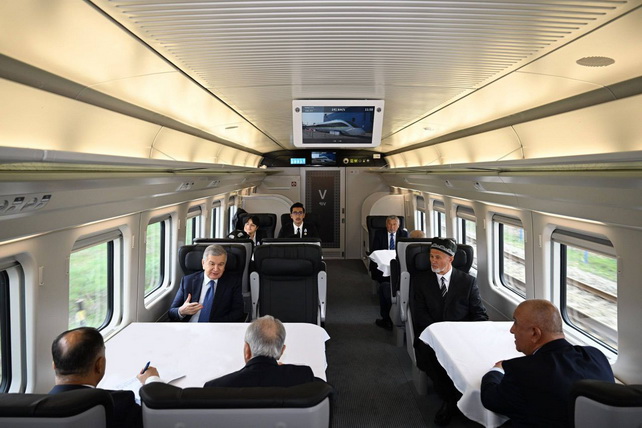
Mirziyoyev Tests Hyundai Rotem High-Speed Train
Tashkent, Uzbekistan (UzDaily.com) — President Shavkat Mirziyoyev traveled from Samarkand to the Narpay district aboard a new high-speed train manufactured by Hyundai Rotem, marking the introduction of advanced rail technology in Uzbekistan.
The train, named after Jaloliddin Manguberdi, is the first of six units planned for delivery. It consists of seven carriages, has a total length of 175 meters, and can reach speeds of up to 260 kilometers per hour. With a capacity of around 390 passengers, it offers VIP, business, and economy classes. The design features a white exterior with tinted windows and elements reflecting the national flag.
Adapted to Uzbekistan’s климатические условия, the train is equipped with systems resistant to dust, extreme temperatures, and sandstorms, enabling reliable operation on long-distance routes. It is expected to begin service on the Tashkent–Urgench–Khiva route, reducing travel time to approximately seven hours.
During the поездка, the president met with local residents, ветераны труда, and youth representatives to discuss ongoing reforms and initiatives aimed at improving living standards.
Upon arrival in the Narpay district of Samarkand region, Mirziyoyev visited a modern greenhouse complex specializing in hydroponic strawberry cultivation. The project, implemented by the “Narpay qulupnay” enterprise with an investment of US$650,000, occupies one hectare and is capable of producing up to 50 tons of strawberries annually. The products are supplied under a local brand to major retail chains, supporting the domestic market with high-quality produce.
Hydroponic technology allows plants to grow without soil, using nutrient-rich solutions. Root systems develop in coconut substrate, improving water retention and enabling direct delivery of minerals. This approach reduces plant energy consumption, accelerates growth, and significantly increases yields compared to traditional farming methods.
The system also enables large-scale production on limited land while reducing water usage by up to 80%. Lower disease risks minimize the need for chemicals, ensuring environmentally friendly output.
The greenhouse incorporates water-saving technologies, including rainwater collection systems, automated hydroponic equipment, solar panels, and energy-efficient lighting, helping to reduce production costs.
Plans were presented to expand the project to 60 hectares, potentially increasing output to 300,000 tons annually and creating new jobs. The president emphasized the importance of scaling such initiatives, including at the household level, to ensure stable year-round agricultural supply and increase incomes.
He highlighted the need to leverage modern technologies, including artificial intelligence, enhance public skills, and disseminate best practices to strengthen the sector’s sustainability and productivity.