Stay up to date with the latest news
Subscribe to our telegram channel

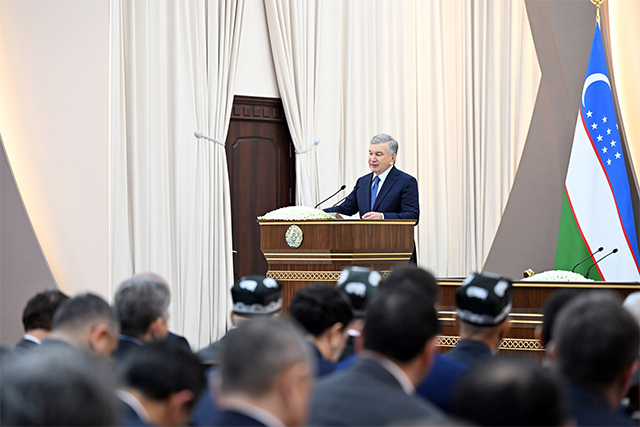
Mirziyoyev Sets Ambitious Goals for Samarkand Region
Tashkent, Uzbekistan (UzDaily.com) — Under the chairmanship of President Shavkat Mirziyoyev, a meeting on the socio-economic development of Samarkand Region was held in the Narpay district. The President opened the session by warmly congratulating attendees on the upcoming Eid al-Fitr and Navruz celebrations.
Mirziyoyev noted that significant changes have taken place in the country in the four months since his last visit to Samarkand. Earlier this week, the third copper enrichment plant was commissioned in Almalyk, and the Islamic Civilization Center opened in the capital, highlighting Uzbekistan’s spiritual heritage and that of Central Asia. Tomorrow, the Poyarik district will host the inauguration of a memorial complex dedicated to Imam Bukhari, the renowned hadith scholar.
The President emphasized that Samarkand must become a model region in all areas, including employment, poverty reduction, investment attraction, and export growth. Infrastructure improvements are supported by US$100 million allocated to local neighborhoods, with an additional US$50 million directed to the Urgut district. Total regional investments across all sources will reach 11 trillion soms, and entrepreneurs will receive an additional 18 trillion soms in credit resources—figures exceeding all previous allocations.
The initiatives aim to reduce unemployment and poverty, stimulate economic growth, and strengthen industrial capacity. Investments in artificial intelligence and startup projects last year, totaling US$200 million, are expected to enhance data-driven solutions for regional development.
Mirziyoyev highlighted the need to leverage AI to analyze industrial output, service sectors, agriculture, natural and human resources, and professional skills, creating internal development models tailored to each neighborhood. District leaders, working with local “mahalla banks,” will allocate resources to projects that maximize employment and budget revenues. This system will be implemented in Narpay and Termez districts by May 1, serving as a nationwide model.
For Samarkand Region as a whole, targets include at least 9% economic growth, a gross regional product of 144 trillion soms, US$3 billion in foreign investments, and US$1.2 billion in exports. Plans call for full employment of 100,000 residents, lifting 31,000 families out of poverty, and eliminating unemployment and poverty from the region.
In Narpay district, home to over 240,000 people, unemployment stands at 4.9% and poverty at 5%. Industrial production ranks 9th in the region, while agriculture and services rank 11th. To improve these figures, an additional 100 billion soms will be allocated on top of the previously planned 150 billion soms, and 360 billion soms in resources will support small and medium businesses.
Despite 34 kilometers of major roads and 36 kilometers of railway traversing the district, commercial and industrial development remains limited. Only 10–15 small service points exist along roads, with daily traffic congestion at major intersections such as Mirbozor reaching up to 2 kilometers. Although the district holds a quarter of the region’s construction raw materials and 10% of irrigated land, its contribution to overall industrial and agricultural output remains disproportionately low.
President Mirziyoyev stressed the need for systemic reforms and targeted investments to fully realize the region’s economic potential and serve as a model for Uzbekistan.
Local authorities have been shown ways to address these and other pressing issues.
In Narpay, a 100-hectare industrial zone specializing in high value-added production will be established. Projects totaling US$500 million are planned to launch this year. Officials have been tasked with using artificial intelligence to assess the potential of each mahalla, identify “growth points,” and transform the district into a zone with low unemployment and increased incomes, creating a model based on Narpay’s experience.
Additionally, a strawberry school will be organized, and 25 mahallas in the district will specialize in cultivating this crop. The President paid particular attention to the Kushrabat district, allocating 60 billion soums to improve its entrepreneurial infrastructure.
In five mahallas of the Oktepa area, about 3,000 households are engaged in grape cultivation, while 700 hectares of land are available in the Okchopsoy forest fund. Officials have been instructed to make effective use of these resources by planting 300 hectares of grapes using in-vitro methods, establishing 800 hectares of intensive plantations, converting 3,500 hectares of vineyards to trellis systems, and training residents in viticulture across 18 mahallas.
During an inspection of Kattakurgan district, it was noted that eight hectares of land remain unused across 12 tractor parks in areas with developed infrastructure. The renovation of the Boston-1 pumping station will improve water supply across 1,000 hectares. Furthermore, 830 hectares of cotton and grain land, held in reserve by the district administration and auctioned for three to four months, could be offered to the public under favorable conditions.
Overall, the industrial sector of Narpay, Kushrabat, Kattakurgan, Pakhtachi districts, and Kattakurgan city accounts for only 10 percent of the region’s industrial output. To develop industry in these areas, a program with an allocation of 1.2 trillion soums has been established, of which 800 billion soums will fund industrial infrastructure, and the remaining 400 billion soums will improve roads, water and electricity supply, and support service and renovation projects.
These funds will be used to introduce modern industrial and urban standards in the settlement of Ingichka, located 40 kilometers from Kattakurgan city. In addition, the 60-year-old bridge over the Narpay canal in the city center will be reconstructed. This year, the delivery of 500 electric buses to Samarkand region has been assigned appropriate support measures.
The districts of Narpay, Pakhtachi, Payarik, Kushrabat, Isitkhon, Kattakurgan, and Kattakurgan city have been tasked with developing industry and services, as well as modernizing the appearance of their territories. “As you can see, global instability naturally causes disruptions in supply chains, rising oil prices, and increased transportation costs, which are reflected in food prices. At the same time, around 100 million tourists are seeking safe and peaceful destinations. In this context, the primary responsibility of local leaders must be to increase food production and fully exploit opportunities in tourism and services,” the President emphasized.
Concrete measures have been defined in this regard. Pastures covering 250,000 hectares, used by livestock breeders for many years, have been transferred to direct lease. The region also has 52,000 hectares of land operated by 150 livestock farmers, and hundreds of entrepreneurs have expressed interest in breeding 1,000 head of pedigree sheep and goats.
Therefore, the term of direct lease for pastures has been extended by one more year. Now, all revenues from pasture leases will remain entirely at the disposal of the farms themselves.
Traditionally, residents keep livestock at home and move them to grazing fields in spring and summer. However, the area of available pastures has been decreasing. In response, four districts in the region will establish 43,000 hectares of communal pastures, which will be leased to mahallas free of charge for 30 years.
A budget of 50 billion soums will be allocated for well drilling, water supply, sowing, and the restoration of degraded land. For pedigree livestock breeding, laboratory equipment will be provided, and pedigree animals can be purchased with a ten-year loan at an interest rate of 12 percent per annum.
Samarkand has long been one of the leading regions in poultry farming. Efforts will now be intensified to establish a school of poultry genetics. In this context, a pedigree meat production enterprise worth US$50 million will be launched in Bulungur district, while a pedigree egg production facility worth US$20 million will begin operations in Kushrabat.
Entrepreneurs in Samarkand have requested partial compensation for the installation of solar panels for intensive fish farming to increase yields four to five times and to ensure guaranteed water supply. This initiative has been supported: starting May 1, loans at 16 percent will be provided for solar panel installations, and those who finance the panels independently will be reimbursed 25 percent of their costs.
Last year, 400 billion soums were allocated for potato cultivation on 88,000 hectares nationwide. However, due to untimely organization in the regions, planting did not occur on 48,000 hectares, and only 25 percent of the allocated funds were used.
This year, potato planting is planned on 135,000 hectares, including 22,000 hectares in Samarkand. Officials have been instructed to ensure that potatoes are planted on schedule for every planned area. Specifically, 250,000 mini-potato tubers were imported from Egypt for propagation in Bulungur district, and 6,000 tons of seed potatoes from the Netherlands will be distributed to farmers free of charge, without any markup.
It was noted that an in-vitro laboratory has been launched in Okdarya district with a production capacity of 10 million mini-potato tubers. Forty thousand tons of super-elite seed material prepared there will be distributed free of charge to agricultural producers.
The President also outlined priorities in the tourism sector. Amid instability in the international tourism market, a large-scale campaign has been initiated to promote Uzbekistan as a safe travel destination.
For the tourist season from April to June, a dedicated program, “Open Tourist Season in Uzbekistan,” has been prepared. During this period, airlines will receive subsidies of US$100 for each foreign tourist they bring in. Additionally, carriers will benefit from a 20 percent discount on airport services.
From April 1, tour operators will be granted budget subsidies of up to US$5,000 for every 1,000 foreign tourists attracted over a three-month period. Half of the value-added tax will be returned as a “cashback.”
Fifty foreign bloggers with audiences exceeding five million followers will receive a complimentary seven-day tour package to Uzbekistan. Furthermore, expenses for promoting travel to Uzbekistan on major global online tourism platforms will also be covered.
This year, at least five international artist tours are planned, along with ten business forums and fashion festivals in Samarkand. The city also possesses all the facilities necessary to host Olympiads, forums, and scientific conferences in the natural and exact sciences, positioning Samarkand as an emerging international scientific hub.
For instance, the International Astronautics Congress in 2028 is expected to draw around 10,000 participants from over 100 countries. Officials have been tasked with developing specialized programs in collaboration with international organizations in this field.
Considering these opportunities, the goal has been set to attract six million tourists to Samarkand by the end of the year.
In conclusion, the President emphasized the importance of the upcoming holidays — Ramadan and Navruz. Regional authorities have been instructed to intensify efforts to improve public spaces, streets, and neighborhoods, while also paying special attention to the needs of low-income families, the elderly, and socially vulnerable residents.
In addition, authorities have been instructed to organize fairs offering discounted food products at markets and major shopping centers, ensuring that residents can celebrate the holidays in a cheerful, calm, and safe environment.
The President congratulated all residents of Samarkand on the upcoming holidays, wishing them good health and success in their future endeavors.
During the meeting, reports were heard from the governors of the regions and districts, as well as from other responsible officials, and a dialogue was held with the residents of Samarkand.
#Shavkat Mirziyoyev