Stay up to date with the latest news
Subscribe to our telegram channel

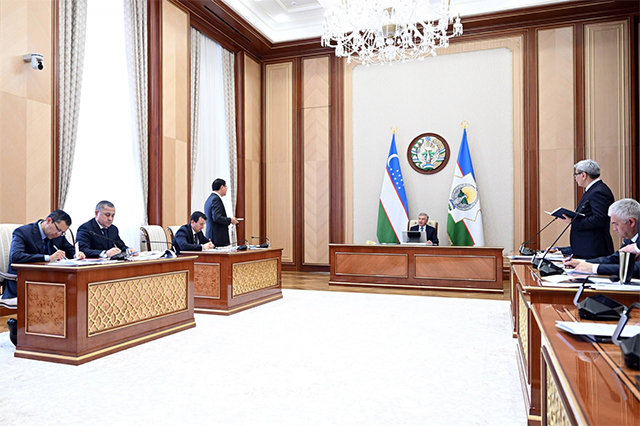
Mirziyoyev Outlines Key Development Goals for Bukhara
Tashkent, Uzbekistan (UzDaily.com) — President Shavkat Mirziyoyev held an extended meeting to review the outcomes of reforms in Bukhara region, assess its economic potential, and define priorities for the near future. The meeting outlined a comprehensive set of targets spanning industrial production, tourism, agriculture, and infrastructure development.
According to data presented, Bukhara’s gross regional product (GRP) grew by 7.2 percent in 2025, reaching 86.6 trillion soms. Industry increased by 7.1 percent, agriculture by 4.3 percent, and the services sector showed the strongest growth at 14 percent. Unemployment fell to 4.7 percent, and poverty decreased to 6 percent compared to 2024 figures.
For 2026, the region has set significantly higher objectives. GRP is projected to reach 102.1 trillion soms, representing a 9.1 percent increase. Industrial output is targeted to rise by 9.1 percent, agriculture by 5.9 percent, and the services sector by 20.1 percent. Unemployment and poverty are to be reduced to 2 percent, ensuring income sources for 381,500 people. Targeted measures will transform Bukhara, Kagan, and several districts into zones free of unemployment and poverty.
In investment, Bukhara is expected to attract US$3.3 billion in foreign investments, achieve US$1.5 billion in exports, and implement projects totaling US$9.2 billion.
Industrial development was a central topic. A portfolio of 61 major projects worth US$2.2 billion was outlined, expected to create 18,000 new jobs. Notable initiatives include an US$350 million facility in Kagan district to produce 80,000 electric and hybrid vehicles annually, creating 500 jobs. Bukhara district plans a US$220 million project to produce benzene, toluene, xylene, pentane, hexane, bitumen, and calcium chloride via pyrolysis. In Karaulbazar, projects include expanding production of AI-91 and AI-92 gasoline (US$85 million) and establishing facilities to produce 100,000 tons of mineral fertilizers per year. Kagan will also see growth in paper, cardboard, and gypsum production.
Each of the 61 industrial zones received sectoral priorities: Bukhara and Bukhara district will focus on food and furniture manufacturing; Vabkent on leather and textiles; Kagan and Karaulbazar on petrochemicals; Shafirkan and Peshku on pharmaceuticals and food; Gijduvan on construction materials.
In agriculture, 100,000 hectares will be developed using modern land-use and irrigation technologies. Cotton yield targets are set at 52 quintals per hectare and grain at 100 quintals per hectare. For livestock, 20,000 pedigree cattle, 30,000 sheep, and 200 horses will be introduced. Modern mini-farms with 50 heads each will be created in every district, resulting in 110 projects, 3,750 jobs, and 51,500 tons of additional milk annually.
Tourism received significant attention. President Mirziyoyev emphasized Bukhara’s unique three-thousand-year history and its concentration of cultural heritage sites as key drivers for economic growth. In 2026, the region aims to host 3.5 million foreign and 5.5 million domestic tourists, totaling 9 million visitors. Plans include 73 new accommodation facilities, 15 tour operators and agencies, five international hotel complexes in the new Bukhara tourism center, and the development of tourism villages such as Khodja Orif, Chor Bakr, and Yorjon, alongside a tourist Mahalla “Mohi Khosa” in the city. An independent administrative system for the historic center, aligned with UNESCO standards, will also be implemented.
For workforce development, a joint faculty with Austria’s Krems University will be established, managing the Bukhara Tourism and Cultural Heritage College and providing training entirely through a dual education system.
Urban infrastructure projects include a 10,000-apartment residential complex in Bukhara district, a new administrative center, residential neighborhoods, a “Yangi Uzbekistan” park, and a campus for Bukhara State University. Road works involve seven bypasses totaling 33.1 kilometers and reconstruction of sections of the G‘uzar–Bukhara–Nukus–Beineu and Samarkand–Bukhara–Turkmenbashi highways. Overall social and production infrastructure investment for 2026 will total 4.484 trillion soms.
At the conclusion of the meeting, the President tasked responsible officials with fully leveraging the region’s potential, converting every initiative into tangible projects, and achieving measurable results across key economic sectors.
#Shavkat Mirziyoyev