Stay up to date with the latest news
Subscribe to our telegram channel

Mirziyoyev Orders 30 Trillion Soums in Additional Revenue Through Digital Tax Controls
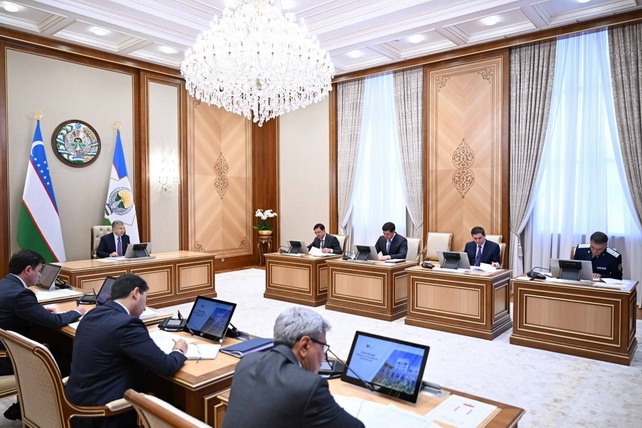
Tashkent, Uzbekistan (UzDaily.com) — Uzbekistan's President Shavkat Mirziyoyev has chaired a government meeting at which a program for improving tax administration and reforming the country's tax authorities was presented.
The head of state set a target to generate an additional 30 trillion soums in budget revenue this year alone through the broad application of digital tools and artificial intelligence.
The meeting acknowledged that over the past two years, tax revenues have been growing at a pace that outstrips the broader economy — driven largely by an expanding tax base and a shrinking shadow sector. The International Monetary Fund has also taken note of these results. As part of an ongoing reform of the tax system, revenues are projected to reach 491.5 trillion soums by 2030, while the share of the unobserved economy is set to fall from the current 28 percent to 19.6 percent.
The further reduction of the shadow economy was identified as the primary reserve for revenue growth. The additional 30 trillion soums are to be generated through monitoring of peer-to-peer transactions, product labeling, strengthened digital oversight, automated detection of unregistered freight activity, and the legalization of informal employment. Trade and services, industry, construction, and food service have been designated as priority sectors.
Special attention at the meeting was paid to markets and retail complexes that have yet to come under full digital oversight. Available data indicates that more than 72,000 retail businesses operate at such venues. Of these, over 38,000 report monthly turnover of less than one million soums, more than 40,000 issue only two or three receipts per day, and the lease agreements of 12,000 retail outlets have never been registered for tax purposes. As a result, 37,000 entrepreneurs pay less than 500,000 soums in taxes each month. A decision was taken to fully digitize market operations and integrate oversight mechanisms with tax monitoring tools.
The meeting also addressed the management of large non-strategic taxpayers in the regions. The distance from central tax authorities has diminished the quality of service for 209,000 VAT payers. As a remedy, it was proposed to transfer oversight of 500 non-strategic enterprises to the regional level, and to shift more than 103,000 enterprises in agriculture, trade, and food service to the district level.
A substantial portion of the meeting was devoted to simplifying tax administration for businesses. Surveys of entrepreneurs revealed widespread dissatisfaction with the complexity of audits, reporting requirements, and tax payment procedures. In response, it was proposed to transform the desk audit system from a punitive instrument into a preventive mechanism designed to identify and correct errors at an early stage. A risk-based classification of enterprises into three categories — green, yellow, and red — was also put forward.
Progress was reported on the automation of six types of tax reporting without human involvement and on the transition to a unified tax account. Available data shows that filing deadlines have been missed in 198,000 cases, 14,700 taxpayers have been fined a combined 396.6 billion soums for non-submission, and 20,000 errors have been recorded due to duplicated tax payment accounts. The introduction of the new system is expected to save entrepreneurs an estimated 8.4 trillion soums by eliminating unjustified debts, overpayments, and penalties.
The human capital of the tax authorities was recognized as a serious challenge. In recent years, staff turnover has increased while retraining rates have fallen sharply: whereas more than 3,000 employees completed professional development courses in 2022, only 700 did so last year. Proposals were presented for establishing a continuous education system, improving financial incentives, and strengthening the material and technical base of the Tax Academy under the Tax Committee.
At the conclusion of the meeting, the president directed officials to introduce a fundamentally new model of tax administration grounded in digital technology and data analytics, to build a corps of qualified specialists, and to shift the system from an audit-driven logic to a service-oriented one — creating a favorable and equitable tax environment for entrepreneurs.
#Shavkat Mirziyoyev