Stay up to date with the latest news
Subscribe to our telegram channel

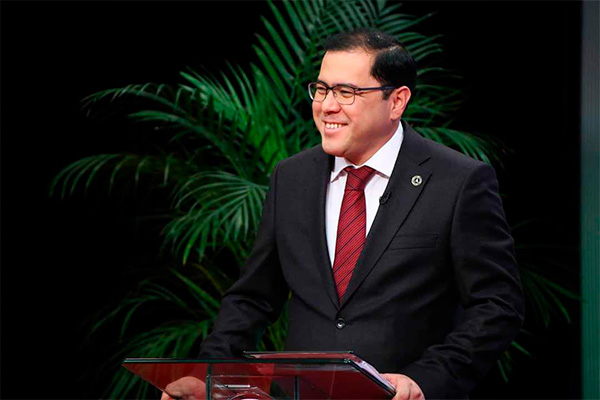
Kudratkhodja Labels Solovyov’s Statements on Central Asia as Colonial Thinking
Tashkent, Uzbekistan (UzDaily.com) — Sherzodkhon Kudratkhodja, Rector of the University of Journalism and Mass Communications of Uzbekistan, sharply criticized Russian TV host and political commentator Vladimir Solovyov for his statements regarding Russia’s so-called “zone of influence,” in which he mentioned Armenia and the countries of Central Asia.
In his Telegram channel, Kudratkhodja called such rhetoric “unchecked propaganda,” noting that Solovyov, in a live broadcast, voiced what had previously, in his view, been deliberately concealed. The professor emphasized that this concerns the disregard of international law, reducing sovereignty to a formality, and viewing other states not as independent actors but as objects.
He highlighted that Solovyov’s use of the expression “Our Asia” is not a mere slip of the tongue, but an example of colonial language, where borders are seen as obstacles and countries as parts of someone else’s “sphere of influence.”
Kudratkhodja recalled that Solovyov had previously publicly described the attack on Ukraine as a crime and a path to disaster. According to the rector, that characterization has now been replaced without hesitation by the term “necessity,” clearly demonstrating how propaganda erases memory and encourages the audience to do the same.
He added that such statements might be dismissed as emotional or intended for effect on air, but history shows that such “solo performances” rarely remain mere words. In public politics, he argued, thoughts spoken aloud cease to be philosophy and become rehearsals for action.
According to Kudratkhodja, this rhetoric does not constitute analytical debate but normalizes war as an acceptable tool of policy. Ukraine, he said, has already become a precedent; Central Asia is now the subject of openly voiced fantasies; and the concept of a “zone of influence” serves as a universal justification for violence, masked as concerns for security.
When statements like “ignore the law” are broadcast, he stressed, it is not rhetorical flourish—it signals intent. Kudratkhodja also warned that the continuation of such logic is both obvious and particularly dangerous. If international law is deemed optional and sovereignty conditional, there are no allies, guarantees, or stable agreements left. Only the law of force remains, rebranded as “security,” where states become movable elements on a map, to be shifted or erased according to prevailing rhetoric.
He noted that today, such ideas are voiced on air, tomorrow they are embedded in political language, and the day after they materialize into concrete actions. History, Kudratkhodja stressed, has already followed this path: first comes verbal arbitrariness, then violence becomes a conventional explanation, and finally comes the surprise of “nobody understood” and “everyone suddenly opposed it.” Propaganda, he noted, always relies on the illusion that consequences can be undone as easily as yesterday’s statements, but reality works differently.
In the 21st century, he said, war no longer needs to be formally declared—normalizing it in public discourse, repeating that “this is necessary” and “we are allowed,” is sufficient. Kudratkhodja argued that this is precisely how the Overton window operates: the unthinkable becomes discussable, then permissible, and ultimately actionable.
He emphasized that the danger of such broadcasts lies not so much in their content as in their function—they shift the boundaries of the acceptable and prepare society for the next step. The question, he argued, concerns not only a single TV host but also those who regard such formulations as acceptable.
In conclusion, Kudratkhodja stated that history, unlike propaganda, forgets nothing and only waits for the moment when words spoken aloud provide sufficient evidence that the choice was made consciously.