Stay up to date with the latest news
Subscribe to our telegram channel

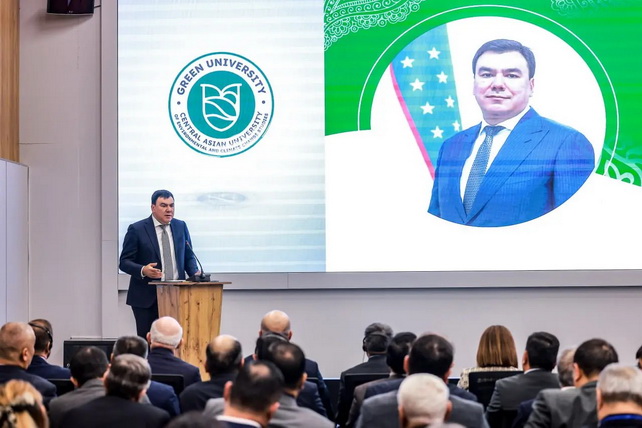
International Experts Discussed Nature-Based Solutions to Environmental Challenges in Tashkent
Tashkent, Uzbekistan (UzDaily.com) — On 19–20 December, the III International Scientific and Practical Conference “Nature-Based Solutions to Environmental Challenges” was held at the Central Asian University for Environmental Studies and Climate Change (Green University).
The event brought together representatives of government agencies, scientific and educational institutions, non-governmental and international organizations, as well as specialized experts from abroad.
The conference opened with the participation of the Adviser to the President of the Republic of Uzbekistan on environmental issues and Chairman of the National Committee for Ecology and Climate Change, Aziz Abdukhakimov; Vice President of the Academy of Sciences of the Republic of Uzbekistan Shakhlo Turdikulova; representative of the Ministry of Water Resources of the Republic of Uzbekistan Rashid Toshev; Head of the Ecological Party of Uzbekistan faction in the Legislative Chamber of the Oliy Majlis Abdushukur Khamzaev; and the Regional Coordinator of the International Union for Conservation of Nature (IUCN) for Central Asia, Dmitry Gorshkov. During the welcoming session, Aziz Abdukhakimov introduced the newly appointed Rector of Green University, Bakhtiyor Pulatov.
In his address, the Chairman of the National Committee for Ecology and Climate Change noted that Uzbekistan is facing a complex set of serious environmental challenges, including climate change, water scarcity, biodiversity loss, land degradation and salinization, as well as atmospheric air pollution.
It was emphasized that these factors have a significant impact on the environment, the economy, the social sphere, and public health.
The aim of the conference was to comprehensively discuss the scientific, theoretical, and practical aspects of implementing environmental reforms based on the principles of sustainable development and the introduction of advanced nature-based technologies.
Special attention was drawn to the fact that 2025 has been declared the “Year of Environmental Protection and the Green Economy” in Uzbekistan. It was noted that the transformation of the relevant authority into the National Committee for Ecology and Climate Change represents an important institutional step toward elevating environmental policy to a qualitatively new level.
Within the framework of the “Uzbekistan – 2030” Strategy, ambitious goals have been set, including increasing the level of greening to 30 percent, expanding forested areas in the Aral Sea region to 2.3 million hectares, establishing protective forest plantations on 600,000 hectares to combat desertification, droughts, and dust and sand storms, expanding the network of specially protected natural areas, and raising the share of green energy to 54 percent. In addition, Uzbekistan has committed to reducing greenhouse gas emissions by 50 percent by 2035 under the Paris Agreement.
Emphasizing the importance of international cooperation, Aziz Abdukhakimov noted that environmental and climate challenges are transboundary in nature and require coordinated efforts.
In this context, the opening of the IUCN regional office at Green University was highlighted as evidence of the high level of trust of the international community in Uzbekistan’s role in promoting scientifically grounded solutions to environmental problems in Central Asia.
Confidence was also expressed that the Central Asian Center for Environmental and Ecological Research, established jointly with the Xinjiang Institute of Ecology and Geography of the Chinese Academy of Sciences, will become a key scientific platform for conducting regional research.
During the plenary session of the conference, reports by leading domestic and international experts were presented, focusing on current environmental and water management challenges facing Uzbekistan, as well as possible ways to address them in the context of climate change. Particular attention was given to the formation of a green economy, the logic of its development, and innovative areas for the implementation of environmentally oriented technologies.
Online presentations examined nature-based approaches to ensuring access to clean water, the development of green energy, and international experience in implementing nature-positive policies aimed at enhancing the climate resilience of water and pasture ecosystems.
Participants were presented with scientific assessments of the potential of nature-based solutions for restoring ecosystems in the country’s arid regions.
The discussions also covered the introduction of water-saving technologies and their impact on water resources and agricultural productivity in arid zones, the management of climate and natural risks in cities using modern tools, integrated approaches to land-use assessment, and strategies for the sustainable management of river basins.
Special attention was given to international initiatives aimed at accelerating innovation in the field of nature-based solutions, as well as to the analysis of sources of atmospheric air pollution and measures to improve air quality monitoring and management systems, using the city of Termez as an example.
Over the course of two days, conference participants discussed current scientific approaches and practical solutions in the field of nature-based technologies aimed at enhancing environmental sustainability and adaptation to climate change, with a focus on developing international scientific dialogue and strengthening cooperation.