Stay up to date with the latest news
Subscribe to our telegram channel

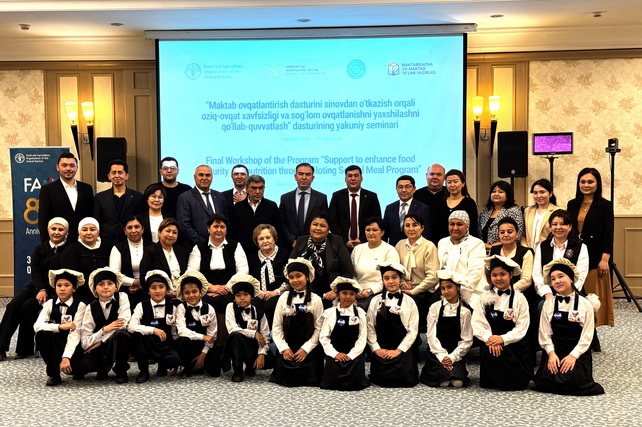
FAO and Uzbekistan Review Results of a Pilot Project on the Development of School Feeding
Tashkent, Uzbekistan (UzDaily.com) — The Food and Agriculture Organization of the United Nations (FAO), together with the Ministry of Preschool and School Education, the Ministry of Health, the Ministry of Agriculture, and local authorities, has summed up the results of the project “Supporting Improved Food Security and Nutrition through Piloting a School Feeding Programme.” The project’s final seminar was held in Tashkent.
The event focused on analysing the results achieved, discussing practical experience and lessons learned, and considering prospects for the sustainable development and scaling up of school feeding initiatives in Uzbekistan.
The seminar brought together representatives of relevant ministries and agencies, local authorities, development partners, national and international experts, representatives of pilot schools, parents, and students. Participants discussed the key outcomes of the project and possible mechanisms for institutionalising successful practices at the national level.
School feeding remains one of the priority areas of Uzbekistan’s state policy, given its important role in improving children’s nutrition, ensuring food security, enhancing the quality of education, and strengthening health in the long term.
Schools are viewed as an effective platform for shaping healthy eating habits from an early age, with a positive impact on families, communities, and local food systems.
Since its launch, the FAO project has contributed to strengthening the school food environment through the introduction of science-based approaches to nutrition education, improvements in food safety practices, the development of educational and methodological materials, the implementation of awareness-raising activities, and support for national dialogue on sustainable school feeding.
The project was implemented in close cooperation with government bodies and pilot schools, which made it possible to test practical solutions and strengthen institutional capacity.
Opening the seminar, representatives of FAO and the relevant ministries highlighted the importance of intersectoral cooperation in ensuring safe, nutritious, and sustainable school feeding. It was noted that the project has contributed to ongoing reforms in the areas of education, health, and food systems development in the country.
“This project has made it possible to pilot practical approaches to organising school feeding in Uzbekistan,” said Sherzod Umarov, Deputy FAO Representative in Uzbekistan. “The experience of cooperation with national partners and pilot schools helps to more clearly identify effective models in the field of school feeding and food security.”
As part of the programme, the key results of the project were presented, including educational materials for students, teachers, and school canteen staff, as well as video and communication products developed during the implementation of the initiative.
Representatives of pilot schools in the Zangiata district—students, teachers, principals, and parents—shared their practical experience and noted the positive impact of the project on the school environment and on awareness of healthy nutrition.
FAO experts presented a comprehensive overview of the project’s outcomes, including a SWOT analysis and strategic recommendations for the future.
Alongside the achievements, the discussions also identified remaining challenges, such as infrastructure constraints, the need to strengthen intersectoral coordination, and the development of unified standards in the areas of nutrition and food safety.
Participants also explored opportunities for scaling up successful approaches at the national level.
Among the priority areas identified were the development of intersectoral cooperation, strengthening links between school feeding and local agriculture, expanding nutrition education programmes, and ensuring the long-term sustainability of initiatives. FAO confirmed its readiness to continue supporting Uzbekistan in integrating school feeding programmes into national systems.
The final seminar confirmed that investments in healthy school feeding are a contribution not only to the well-being of children, but also to the sustainability of food systems, the development of the local economy, and the creation of a healthier future for Uzbekistan.