Stay up to date with the latest news
Subscribe to our telegram channel

Education in Japan Supports the Development of Uzbekistan’s Human Capital
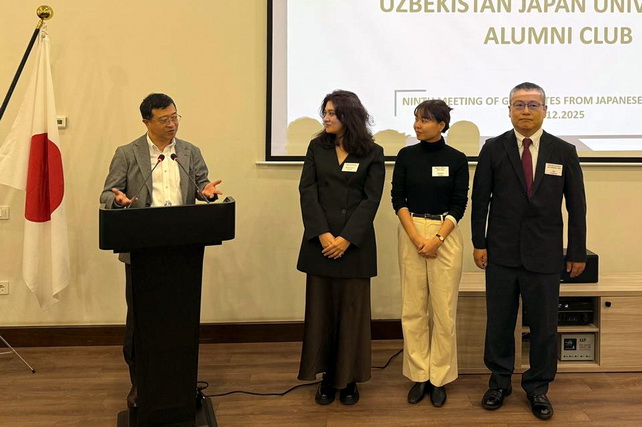
Tashkent, Uzbekistan (UzDaily.com) — The Alumni Club of Japanese Universities held its latest meeting. On 6 December 2025, graduates who had pursued education and professional growth in Japan gathered at the residence of the Japanese Ambassador to Uzbekistan.
The Club has grown in both membership and activity, with this being its ninth meeting. Members are united by their connection to Japan and their shared desire to apply the best of the international experience they have gained for the development of their home country, Uzbekistan.
“Since Uzbekistan is an important strategic partner of Japan, I sincerely hope that your experience gained in Japan will contribute to the economic and social development of Uzbekistan,” said Ambassador Kenji Hirata while welcoming the participants.
He noted that Japan was one of the first countries to establish educational cooperation with Uzbekistan following its independence. Since 1996, Japan has implemented the MEXT scholarship program, which allowed 556 young Uzbeks to pursue higher education in Japan.
To support Uzbekistan’s development, Japan has also run the JDS scholarship program since 1999 through JICA and JICE, enabling around 360 Uzbeks to study in Japan. Thanks to these programs, as well as the JASSO scholarships and other exchange initiatives, over 1,000 young Uzbeks have continued their education in Japan.
The knowledge and skills acquired in Japan have significantly contributed to the professional growth of graduates. Many play key roles in various sectors of society, with some holding high-ranking positions, including ministerial posts.
Ambassador Hirata highlighted the strong historical and cultural ties between the peoples of Japan and Uzbekistan. He also emphasized a shared desire to maintain friendly relations with countries in the region, exemplified in recent years by the development trajectory of the “New Uzbekistan” under President Shavkat Mirziyoyev.
Japan, in turn, possesses significant experience in industrial development, which it is ready to share with Uzbekistan and other Asian countries.
Each Club meeting also features presentations on experiences in Japan. This time, Oleg Ryzhichenko, Director of the U-ENTER Innovation Center, spoke about his recent visit to the World Expo “Osaka Expo 2025.” In September, a delegation of residents and staff from the Center explored the Expo.
Ryzhichenko noted that although he had studied at Waseda University in Tokyo from 2011 to 2013, the September visit brought many new discoveries and impressions. “It was my second trip to Japan, and despite having lived there for two years, I continued to be amazed by the pavilions and interactions with Japanese people. On the day we visited the Expo, over 250,000 people attended, and yet we traveled there and back by metro without any issues. The Expo itself was immense — the largest event I have ever attended. It was like a city with over 160 national pavilions, including Uzbekistan’s,” he said.
He emphasized that the Uzbek pavilion was recognized as one of the most successful across many categories and nominations, and visitors had to wait in line for at least an hour to enter.
“The trip was also a wonderful opportunity to engage with Japanese culture, cuisine, architecture, urban planning, and history — all aspects of a country that constantly amazes and inspires,” Ryzhichenko added.
Another Waseda University alumnus, Nodirbek Yarashev, studied at the university’s master’s program from 2011 to 2014. Today, as a lawyer, he supports Japanese businesses operating in Uzbekistan.
Even during his studies, he gained legal practice experience in Japan. The skills he acquired now help implement Japanese innovations in Uzbekistan in sectors such as IT, infrastructure, and others.