Stay up to date with the latest news
Subscribe to our telegram channel

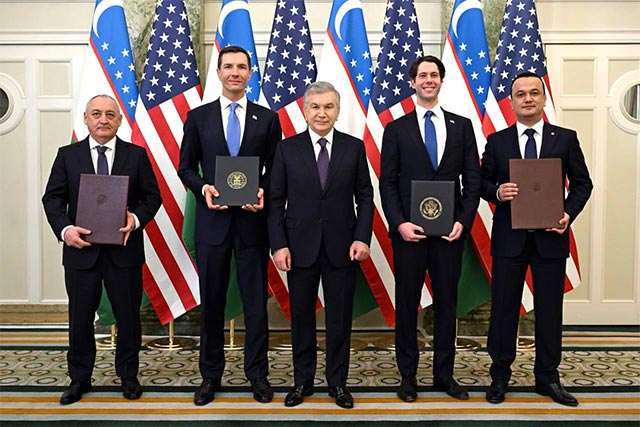
DFC and Uzbekistan Launch Joint Investment Platform for Strategic Projects and Critical Minerals
Tashkent, Uzbekistan (UzDaily.com) — The U.S. International Development Finance Corporation (DFC) has announced the launch of historic cooperation with the Government of Uzbekistan aimed at expanding private investment in strategic sectors and implementing mutually beneficial projects.
The signing ceremony took place in Washington during the first session of President Donald Trump’s Peace Council. Documents were signed by DFC CEO Ben Black, EXIM Chairman John Jovanovich, Uzbekistan’s Minister of Investment, Industry, and Trade Laziz Kudratov, and Executive Director of the Uzbekistan Reconstruction and Development Fund Shukhrat Vafaev, in the presence of President Shavkat Mirziyoyev.
DFC CEO Ben Black highlighted the strategic significance of the Trans-Caspian Corridor region and emphasized that the agreement represents the first step in deepening the growing partnership between the U.S. and Uzbekistan. He noted that the corporation will work closely with regional partners to strengthen critical supply chains and stimulate economic growth in both countries, ensuring leadership for the U.S. and Uzbekistan in the future of global trade and innovation.
The signed Heads of Terms outlines the parties’ intention to create a Joint Investment Platform to advance strategic cooperation. The platform will facilitate the identification of mutually beneficial investment opportunities, promote shared economic interests, and stimulate joint investments in key economic sectors, including critical minerals, infrastructure, and energy.
Special emphasis will be placed on investments across the entire value chain of critical minerals—from exploration and extraction to processing and downstream use. Within the platform, a U.S.–Uzbek joint holding company is also planned to support collaborative investment initiatives.
DFC sees broad economic opportunities in Uzbekistan and throughout Central Asia, ranging from expanding trade along the Trans-Caspian Corridor to global demand for critical minerals and regional demand for reliable energy. The corporation intends to stimulate economic growth in Uzbekistan by attracting private investment into priority infrastructure, energy, and critical resource sectors.
The agreement follows a recent expansion of DFC’s powers granted by the U.S. Congress, including the removal of geographic restrictions, an increase in capital to US$205 billion, expanded equity investment capabilities, and the creation of a new revolving fund. These changes position DFC as a key instrument of U.S. economic state policy within the foreign policy strategy of the Donald Trump administration.