Stay up to date with the latest news
Subscribe to our telegram channel

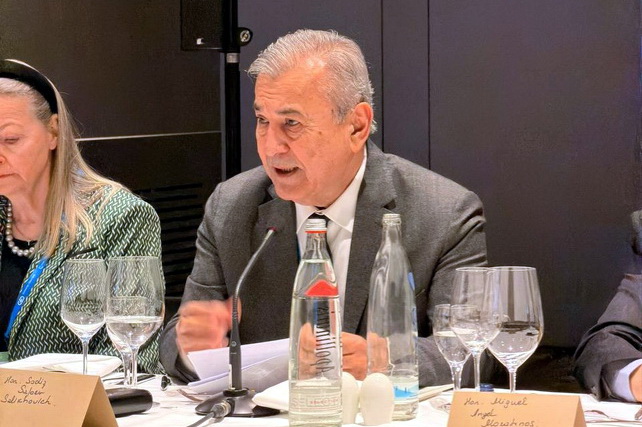
Connectivity as a Security Asset: Uzbekistan Outlines New Approaches to Regional Stability at the Munich Security Conference
Tashkent, Uzbekistan (UzDaily.com) — On 15 February 2026, in Munich (Germany), a panel discussion titled “The Golden Mean? Connectivity, Security and the Caspian Middle Corridor” was held as part of the 62nd Munich Security Conference. The event was organized by the U.S.-based Caspian Policy Center.
The discussion took place against the backdrop of profound global changes in transport and logistics, as the reconfiguration of supply chains, the search for alternative routes, and growing competition for control over transport corridors increasingly shape economic security.
The Middle Corridor, linking Asia and Europe via the Caspian Sea, the South Caucasus and Türkiye, is gaining strategic importance as critical infrastructure for the broader Eurasian space, particularly amid the geopolitical risks facing traditional routes.
Participants included Assel Zhanassova, Deputy Head of the Presidential Administration of Kazakhstan, Helga Schmid, President of the European Institute of Peace, Eduards Stiprais, the European Union Special Representative for Central Asia, as well as officials from regional states and European institutions. Uzbekistan was represented by Sadyk Safaev, First Deputy Chairman of the Senate of the Oliy Majlis, and Eldor Aripov, Director of the Institute for Strategic and Interregional Studies.
In his remarks, Sadyk Safaev stressed that connectivity has ceased to be merely a technical issue of transporting goods. “It is a strategic question of economic resilience, supply chain sovereignty, and the ability to remain open under pressure—whether from geopolitical shocks, climate change, or technological disruptions,” he said.
The senator highlighted Uzbekistan’s consistent implementation of a strategy to modernize transport infrastructure, encompassing the development of rail and road networks, the creation of multimodal routes, and the introduction of digital solutions that simplify border procedures and enhance logistics predictability for businesses. The goal of these efforts, he noted, is to make connectivity reliable, transparent, and competitive.
Participants praised Uzbekistan’s pragmatic approach to developing regional transport connectivity and underscored the growing importance of the Middle Corridor for the economic security of Central Asian countries and their European partners.
Safaev cited specific figures, noting that Uzbekistan’s external trade cargo volumes have doubled over the past five years, reaching 1.2 million tonnes by the end of 2025. The share of cargo transported to European Union countries via the Middle Corridor increased from 12 percent in 2021 to 28 percent in 2025.
He also emphasized the need for substantial investment to unlock the route’s full potential. According to estimates by the European Bank for Reconstruction and Development, modernization of the Trans-Caspian route will require approximately €18.5 billion to rehabilitate railways and roads, expand rolling stock, increase port capacity, upgrade border crossings, and establish multimodal logistics hubs across Central Asia.
“For Uzbekistan, as a landlocked country, access to efficient transport corridors directly affects transport costs, export competitiveness, and the ability to diversify trading partners. This is not an option but a strategic necessity,” Safaev emphasized.
In conclusion, the First Deputy Chairman of the Senate noted that the Middle Corridor should be viewed not only as an infrastructure project but also as a platform for cooperation, linking Europe, Central Asia, and Eurasian partners on the basis of shared interests in resilience, economic growth, and stability through interdependence.
The Caspian Policy Center is a U.S. analytical institution specializing in energy security, regional integration, and the geopolitics of the Caspian region and Central Asia. The Middle Corridor is a transport route connecting Asia and Europe via the Caspian Sea, the South Caucasus, and Türkiye, and is regarded as a strategic alternative to northern routes amid geopolitical turbulence.