Stay up to date with the latest news
Subscribe to our telegram channel

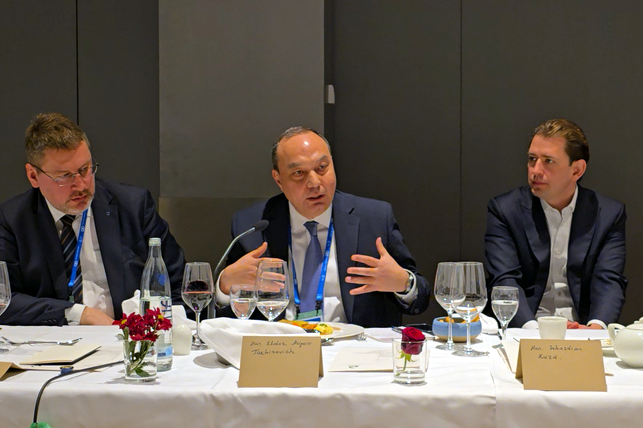
Central Asia as a New Pillar of Eurasian Stability: Uzbekistan’s Security Vision Presented in Munich
Tashkent, Uzbekistan (UzDaily.com) — On 14–15 February 2026, at the 62nd Munich Security Conference in Germany, Central Asia was highlighted for the first time in the forum’s history as a cohesive region with its own model of peaceful transformation, sustainable development, and regional responsibility.
This perspective emerged during discussions organized by the International Nizami Ganjavi Center (Azerbaijan) and the Caspian Policy Center (USA). Key speakers included Turki Al-Faisal bin Abdulaziz Al Saud, Chairman of the Board of the Center for Islamic Studies in Saudi Arabia; UN Deputy Secretary-General Miguel Ángel Moratinos; UNCTAD Secretary-General Rebeca Grynspan; former Austrian Federal Chancellor Sebastian Kurz; Helga Schmidt, President of the European Institute of Peace; and European Union Special Representative for Central Asia, Eduards Stiprais.
The Uzbek delegation was represented by Sadyk Safaev, First Deputy Chairman of the Senate of the Oliy Majlis of Uzbekistan, and Eldor Aripov, Director of the Institute for Strategic and Interregional Studies under the President of Uzbekistan. Their interventions provided a conceptual framework positioning Central Asia as one of the few regions in Eurasia that, over the past decade, has transitioned from conflict-prone dynamics to sustained cooperation.
Speaking at the session hosted by the Nizami Ganjavi Center, Eldor Aripov emphasized the historical significance of holding a dedicated, substantive discussion on Central Asia at the Munich Conference. “For a long time, Central Asia was outside the main analytical and political focus. Information about the region was fragmented and outdated. Today, for the first time, we are discussing Central Asia not only as a region that has transformed itself but also as one capable of contributing positively to the global security discourse,” he noted.
Aripov highlighted that this transformation is particularly striking against the backdrop of global escalation and polarization. While many parts of the world are facing increasing instability, Central Asia demonstrates an alternative trajectory: dialogue, pragmatism, and rejection of zero-sum logic.
He recalled that just ten years ago, the region was associated with closed borders, unresolved territorial and water disputes, occasional armed incidents, and mined border zones—factors directly affecting millions of people’s lives. Today, the situation is fundamentally different.
Regional trade among Central Asian countries has more than doubled, mutual investment has grown nearly fivefold, and cross-border mobility has returned to levels unseen for decades. Notably, even during the COVID-19 pandemic, countries maintained open borders for the delivery of essential goods, reflecting collective resilience and mutual trust.
“The main lesson from Central Asia is that it is not geography that has changed, but political thinking. The key factor has been the political will at the highest level. The President of Uzbekistan made a conscious choice for stability and development over confrontation, proposing a formula adopted by all regional leaders: sustainable development is possible only on the basis of mutual benefit,” Aripov stressed.
He further noted that regional security is no longer viewed solely through a military lens but is understood as a product of development, social stability, and economic interdependence.
The role of local communities was also emphasized. Stability in Central Asia is maintained not only through intergovernmental agreements but also because peace has become tangible for ordinary people—through trade, tourism, and cross-border cooperation. This approach underpins the Ferghana Peace Forum, initiated by the President of Uzbekistan in October of the previous year.
“The Ferghana Dialogue has become a platform where governments, international organizations, experts, and local communities work together. Its aim is not only to document progress but to make Central Asia a source of practical lessons in conflict prevention and trust-building for other regions,” Aripov said. The forum’s outcomes include institutionalizing it as a permanent platform for dialogue focused on long-term regional stability and sharing its experience globally.
This discussion naturally extended to a session hosted by the Caspian Policy Center, where the growing interconnectedness of Central Asia and the South Caucasus along the Middle Corridor was examined. Aripov emphasized that strengthening links between these regions reflects a deep structural shift in Eurasia. “This is not about creating new blocs or formal alliances but about functional interdependence grounded in practical interests—transport, trade, energy transition, and supply chain resilience,” he said.
It was noted that Uzbekistan’s President was among the first to recognize this strategic dimension, proposing the inclusion of Azerbaijan in Central Asian regional cooperation. According to participants, this initiative reflects a new reality in which economic interconnectedness raises the costs of instability and thereby helps prevent conflict.
Uzbek representatives’ interventions in Munich demonstrated that Central Asia is increasingly seen as part of the solution, not a source of problems. Creating a corridor of cooperation from Central Asia through the South Caucasus to the Black Sea could establish an extensive zone of stability impacting all of Eurasia.
The attention and active engagement generated by the Uzbek delegation confirmed the global demand for Central Asian expertise in an era of growing uncertainty. As Aripov noted, regions where security is built on trust, economic interdependence, and pragmatic political decisions should occupy a stable place in the global security architecture.
In this context, the peace initiatives consistently promoted and institutionalized by Uzbekistan acquire strategic significance: they establish dense networks of economic, transport, and institutional links. Any attempts at escalation immediately incur tangible costs—disrupted transit, broken supply chains, lost investments, and reduced regional interconnectedness—which objectively restrains conflict dynamics and contributes to long-term stability.
During the conference, separate meetings were held with leaders of leading European institutions in security and preventive diplomacy, including Helga Schmidt, President of the European Institute of Peace and Deputy Chair of the Munich Security Conference; Kris Kolter, Executive Director of the Berghof Foundation; Catherine Fieron, Director of the Center for Conflict Prevention and Deputy Head of the OSCE Secretariat; Thomas Greminger, Executive Director of the Geneva Centre for Security Policy; and Eduards Stiprais, EU Special Representative for Central Asia.
These discussions focused on expanding expert and institutional engagement, implementing joint research projects, sharing analytical materials, and deepening cooperation on regional resilience and preventive diplomacy. Special attention was given to strengthening Central Asia’s presence on global discussion platforms.
An agreement was reached to host, during next year’s Munich Security Conference, a major event jointly with Central Asian partners to fully present the region’s voice and vision on international development issues.
The Munich Security Conference is one of the most influential international platforms for discussing global security issues. In 2026, over a thousand participants from more than 115 countries attended, including over 60 heads of state and government.
The International Nizami Ganjavi Center is a leading Azerbaijani think tank specializing in international relations, regional security, and inter-civilizational dialogue.
The Caspian Policy Center specializes in energy security, regional integration, and the geopolitics of the Caspian region and Central Asia.
The Middle Corridor is a transport route connecting Asia and Europe via the Caspian Sea, the South Caucasus, and Turkey, considered a key alternative to northern routes amid geopolitical turbulence.