Stay up to date with the latest news
Subscribe to our telegram channel

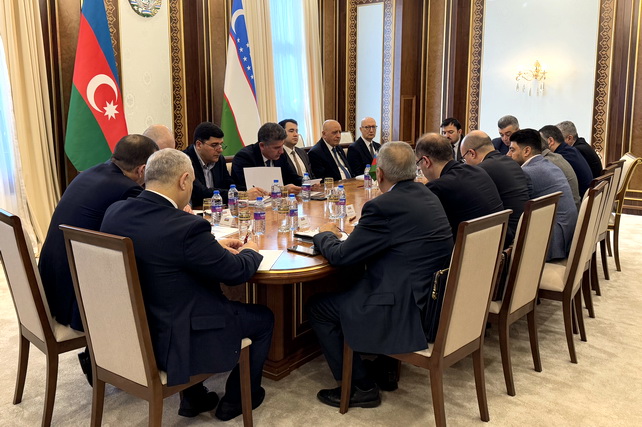
Architecture of Allied Cooperation Between Uzbekistan and Azerbaijan Discussed in Baku
Tashkent, Uzbekistan (UzDaily.com) — On 19 February 2026, a roundtable discussion titled “Uzbekistan–Azerbaijan: The Architecture of Allied Cooperation” was held at the Embassy of the Republic of Uzbekistan in Baku.
The discussion brought together experts from leading analytical centers and research institutions of Uzbekistan and Azerbaijan, including representatives of the Institute for Strategic and Interregional Studies under the President of Uzbekistan and the International Institute for Central Asia.
Participants reviewed the current state of Uzbek–Azerbaijani relations, the most promising areas for economic and investment cooperation, the development of transport and energy corridors, and the potential for collaboration in education, science, culture, and digital transformation.
Particular attention was given to the strategic importance of Azerbaijan’s participation in the Consultative Meetings of the Heads of State of Central Asia, issues of regional identity formation, and strengthening interregional connectivity between Central Asia and the South Caucasus.
The roundtable demonstrated a high level of expert dialogue between Uzbekistan and Azerbaijan and confirmed that their allied partnership is a strategic element of the regional architecture of Central Asia and the South Caucasus, with long-term prospects for economic, cultural, and technological cooperation.
Speaking at the event, First Deputy Director of the Institute for Strategic and Interregional Studies Akramjon Ne’matov emphasized that relations between Uzbekistan and Azerbaijan have undergone a qualitative transformation in recent years. Since 2017, the relationship has evolved from strategic partnership to full-fledged alliance. Whereas cooperation had previously been largely episodic and dependent on current circumstances, it has now reached a high degree of institutionalization and strategic depth.
According to him, this transformation became possible due to the policy of openness and large-scale reforms pursued by President of Uzbekistan Shavkat Mirziyoyev, as well as the strategic course of President of Azerbaijan Ilham Aliyev. Their strategic vision, personal leadership, and trust-based dialogue have been the main drivers of rapprochement.
It was noted that since the establishment of diplomatic relations, a total of 22 mutual high-level visits have taken place, more than half of them over the past eight years. From 2017 to 2025, around 200 visits and meetings at the highest and high levels were held, including those involving prime ministers, ministers, and parliamentary delegations.
A milestone was the signing in 2024 of the Treaty on Allied Relations, which formalized the alignment of long-term interests, mutual support on key international issues, and readiness to coordinate policies in security, economic development, and sustainability.
Ne’matov also stressed the importance of institutionalizing bilateral dialogue. In 2023, a Supreme Interstate Council was established, with its first meeting held in August 2024 and the second in July 2025. Regular consultations are held between foreign ministries, cooperation between security council secretariats began in 2024, and economic blocs of the two governments interact actively. An expert council was launched as a Track II dialogue platform.
In addition, bilateral cooperation has been embedded in broader multilateral formats, including trilateral meetings Uzbekistan–Azerbaijan–Türkiye, Uzbekistan–Azerbaijan–Turkmenistan, the energy partnership Uzbekistan–Kazakhstan–Azerbaijan, and coordination within the Organization of Turkic States, the CIS, and the SCO. As a result, bilateral relations have effectively become a supporting pillar of the regional cooperation architecture.
Special emphasis was placed on interparliamentary and business dialogue. Over the past three years alone, more than 20 high-level interparliamentary contacts have taken place. In 2025, the First Interparliamentary Forum was held in Khiva, resulting in the adoption of the Khiva Declaration and a practical action plan. Parliaments are increasingly acting as active foreign policy stakeholders by providing legislative support for the alliance. Business dialogue has also been institutionalized through the Joint Business Council operating since 2020, while the intergovernmental commission has held five meetings since 2017.
Economic cooperation has shown notable success. Since 2017, bilateral trade has increased 9.5-fold, from US$32.4 million to more than US$300 million in 2025, with an average annual growth rate of 32–34 percent. Uzbekistan’s exports grew eightfold, while imports from Azerbaijan increased sixteenfold, alongside a significant expansion in the range of traded goods. Cooperation is gradually shifting from a raw-material model toward diversified trade with a growing share of value-added products.
Investment and industrial cooperation is also expanding. Around 280 enterprises with Azerbaijani capital currently operate in Uzbekistan. In February 2023, an agreement was signed to establish a joint investment fund with authorized capital of US$500 million, enabling the implementation of major joint projects in mechanical engineering, energy, light industry, and food processing.
The development of interregional cooperation was highlighted as well. Three Forums of Regions have been held in Tashkent, Guba, and Baku, and dozens of sister-city and sister-region agreements have been signed. Over the past two years, the number of paired regions increased from four to eleven, covering 80 percent of Uzbekistan’s territory and key economic and cultural centers of Azerbaijan. This reflects a transition from a vertical interstate model to a network-based interregional partnership involving local authorities and businesses.
Particularly indicative is the 2.1-fold growth in transit cargo transportation, the expansion of air connectivity with 14 regular flights per week, and the strengthening of dense business and humanitarian ties.
Cultural and humanitarian cooperation also plays a significant role. Cross-cultural days, film festivals, exhibitions, and media forums are held regularly. Over the past four years, around 40 joint cultural and humanitarian events have been organized. A landmark achievement was the first Forum of University Rectors in 2025, which brought together more than 130 delegations and demonstrated the emergence of a common educational space.
In concluding remarks, Ne’matov outlined перспективные initiatives to further expand economic cooperation, stimulate interaction between small and medium-sized enterprises, coordinate efforts to ensure food security, strengthen cultural and humanitarian ties, and broaden people-to-people contacts. He stressed that the modern alliance is based on strategic pragmatism, historical and cultural closeness, and shared long-term modernization goals.
“This alliance is not directed against anyone,” he said. “It is aimed at strengthening resilience, developing transport, energy, and humanitarian connectivity, and enhancing the international agency of our states in the emerging multipolar world. Today, Uzbek–Azerbaijani relations are a system-forming element of the Trans-Caspian space and a key axis linking Central Asia and the South Caucasus.”