Stay up to date with the latest news
Subscribe to our telegram channel

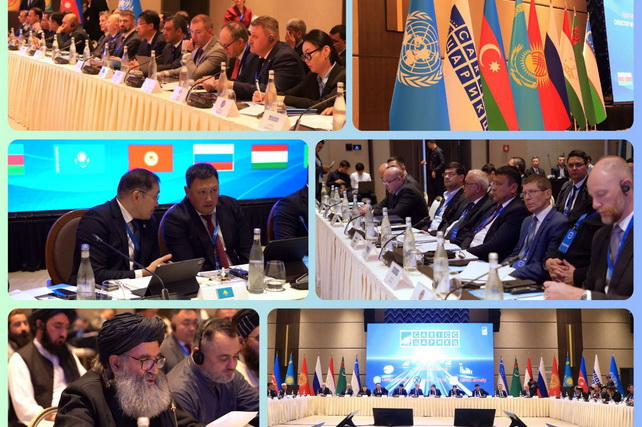
Akramjon Ne’matov: “Regional Cooperation Compensates for Dysfunction in International Coordination”
Tashkent, Uzbekistan (UzDaily.com) — This opinion was expressed by Akramjon Ne’matov, First Deputy Director of the Institute for Strategic and Interregional Studies under the President of the Republic of Uzbekistan (ISMI), during a meeting of the Council of National Coordinators of CARICC, held on December 5, 2025, in Samarkand under Uzbekistan’s chairmanship.
The event brought together representatives of competent authorities from Central Asian countries, Azerbaijan, Russia, China, the United States, and EU member states, as well as international organizations including UNODC, SCO RATS, and CSTO. For the first time, a delegation from Afghanistan participated, led by the Deputy Minister of Internal Affairs.
The meeting focused primarily on enhancing the effectiveness of regional cooperation in combating illicit drug trafficking, strengthening interagency coordination and information exchange, countering the spread of synthetic narcotics, developing preventive measures for youth as a key risk group, and implementing modern digital tools for monitoring and analyzing the drug situation.
According to the ISMI representative, in the current environment, the demand, production, and circulation of narcotics, along with the associated risks, are only set to expand.
He noted that the global context is changing rapidly. Rivalries among major powers are intensifying, the trust crisis is deepening, multilateral international security institutions are becoming less effective, economic fragmentation is growing, and competition over resources is increasing. Sanctions, protectionism, and dysfunction in international law are heightening conflicts and expanding “gray zones.”
It is precisely in these conditions that transnational crime, including the drug trade, is developing rapidly.
According to the expert, the growing scale of the drug threat is determined by several factors.
First, demographic dynamics: the proportion of youth — the main risk group — is increasing, particularly in Asian countries where rapid economic growth is accompanied by the breakdown of traditional social structures, changing behavior patterns, rising inequality, and increased stress. This fuels demand for narcotics.
Second, the spread of armed conflicts and crises creates new zones of weak governance. In these areas, drug production and transnational criminal networks increase, and drug trafficking becomes a source of conflict financing. In some countries, the drug trade becomes part of a “survival economy,” perpetuating long-term instability.
Third, the rapid development of digital technologies, the internet, and artificial intelligence is radically changing the drug market landscape. These tools allow criminal networks to cooperate anonymously, accelerate the circulation of prohibited substances, and complicate detection and control.
Ne’matov emphasized that no single state can effectively counter the transnational drug threat alone. However, geopolitical rivalry, confrontation, and bloc divisions hinder the formation of collective security mechanisms. In the context of the degradation of global collective security institutions, regional formats play a crucial role and can compensate for gaps in international coordination.
The expert stated that Central Asian countries, situated at the intersection of many of these risks, fully understand the magnitude of these processes and demonstrate a high level of responsibility toward their populations.
He noted that in a relatively short period, the region has achieved truly historic progress. Permanent political dialogue has been established between states, trust has been strengthened, and a space of good-neighborliness and partnership has been created.