Stay up to date with the latest news
Subscribe to our telegram channel

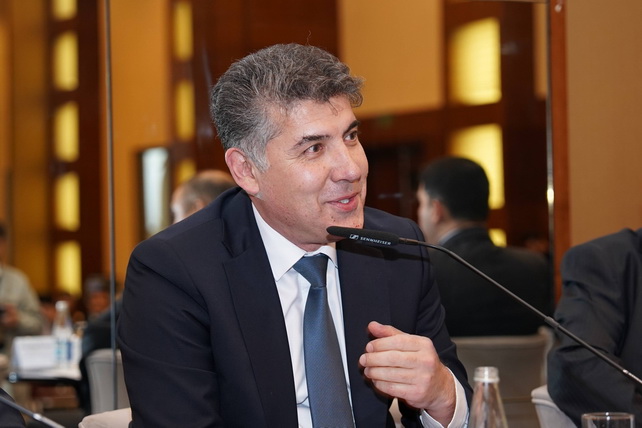
Akramjon Ne’matov: Central Asia Enters a New Phase of Development Characterized by Collective Responsibility
Tashkent, Uzbekistan (UzDaily.com) — In Baku, Azerbaijan, the international conference “C6: One Region, Common Future – Strengthening Strategic Dialogue” was held, organized by the Azerbaijan Center for Analysis of International Relations.
The event brought together leaders and experts from analytical centers, research institutions, and government agencies of Kazakhstan, Kyrgyzstan, Tajikistan, Turkmenistan, Uzbekistan, and Azerbaijan, as well as representatives of civil society and the media.
Uzbekistan was represented by a delegation from the Institute for Strategic and Interregional Studies under the President of the Republic of Uzbekistan (ISMI) and the International Central Asia Institute (ICAI).
Participants discussed key directions for strengthening regional cooperation, including institutionalization of the C6 format, economic interconnectivity, sustainable development, and security challenges amid global changes.
During a session on security issues, ISMI First Deputy Director Akramjon Ne’matov emphasized that the modern international system is undergoing a profound transformation.
“The intensification of confrontational logic, the rise of competing centers of power, and increasing uncertainty create a new reality that will shape the long-term global landscape,” he stated.
He noted that traditional concepts of security now extend beyond military and political dimensions to include socio-economic stability, environmental and climate factors, technological and informational threats.
Ne’matov stressed that in a dynamic and unpredictable external environment, regional approaches and joint response mechanisms become key resources for resilience.
“Central Asia demonstrates a new stage of development characterized by collective responsibility for shared security. The geographic, cultural, and historical proximity of states allows the formation of flexible models that consider national interests and the specifics of threats,” Ne’matov said.
Special attention was given to the principles of flexible institutionalization underpinning the C6 format, which avoids supranational bodies or the transfer of sovereign powers, favoring intergovernmental consensus. This approach ensures strategic autonomy, openness, and pragmatic cooperation, creating a resilient architecture where decisions are made collectively and on the basis of mutual trust rather than zero-sum logic.
The regional model also emphasizes harmonious engagement with international organizations, including the SCO, CSTO, CIS, and TRACECA. According to Ne’matov, the emerging system does not replace existing mechanisms but strengthens them by consolidating the Central Asian approach.
This flexibility has enabled the creation of a multi-level security coordination system that adapts to a changing external environment. A key driver is the Consultative Meetings of Central Asian Heads of State, launched in 2018, which established mechanisms for a developing regional security community. In 2024–2025, meetings of Security Council secretaries were held in Almaty and Samarkand, and for the first time last year, five-party meetings of intelligence chiefs and defense ministers were held in Uzbekistan. Joint military exercises (“Birlik”) and the Regional Forum of Emergency Agency Heads have also been conducted, moving the region from fragmented contacts to systematic intra-regional coordination without external intermediaries.
Ne’matov highlighted two key documents adopted at the 7th Consultative Meeting in Tashkent: the Regional Security, Stability, and Sustainable Development Concept, and the Central Asia Security Risk Catalogue with preventive measures through 2028.
“The significance of the Regional Security Concept is hard to overstate,” he noted. “For the first time, Central Asian countries have jointly defined the nature of threats and mechanisms to address them. This is a major step toward institutionalizing regional agency. The region acts not as an object of external strategies but as a collective actor shaping its own security agenda.”
Key principles of the Concept include indivisibility of security and shared responsibility, emphasizing trust, good-neighborliness, and mutually beneficial cooperation. Economic stability, transport connectivity, balanced water and energy management, technological modernization, and humanitarian exchanges are considered integral elements of overall security.
The Concept complements the 2024 Central Asia Development Strategy through 2040, reinforcing institutional and political conditions for the safe and sustainable implementation of the Strategy. The Security Risk Catalogue provides practical guidance, identifying threats from terrorism and radicalization to cybercrime, climate, and technological risks, and outlines specific coordination, information exchange, and preventive measures.
Ne’matov concluded that Central Asia is gradually emerging as a soft, non-aligned security community built on trust, compromise, and mutual responsibility. This model allows flexible adaptation to external challenges while remaining open to international cooperation.
“The Central Asia–Azerbaijan format can serve as an example of a new type of cooperative security, based on prevention, integration of economic, technological, and humanitarian resources, and collective responsibility,” Ne’matov emphasized. “In doing so, the region can act as a stabilizing factor internationally, promoting strategic autonomy and demonstrating that medium-sized states can establish their own rules and contribute to a resilient global architecture.”